The Essence of Life

The Essence of Life

Saturday, October 20, 2012

Woodcock


A new experience in Northern Michigan

This weekend my wife and I came to Traverse City, Northern Michigan Lower Peninsula, to enjoy the fall colors, relax and pick-up two shotguns that Del Whitman (www.dcwhitmangunsmithing.com) was working on for me.

Although the weather was less than great (and that is being positive), we had fantastical views during the almost three-hour drive, with all tones of auburn, yellow, copper, orange and red blasting out of the landscape, with patches of ever greens trespassing here and there.

My wife and I first came to Traverse City during the US Labor Day weekend (first Monday of September) and we fell in love with the place. We needed vacations and wanted to spend a lot of time together doing “nothing at all”, but I used the opportunity to meet Del, who was recommended by my friend Tony South, and drop the two shotguns that needed work.

One of the shotguns is a little Beretta 28 gauge side-by-side box lock that my mother bought in 1969 to my dad as a wedding gift. The well balanced gun was probably made in the late 1950’s, and although mechanically solid, the old lady needed some “make-up”.

While discussing the project with Del – lengthening the chambers to 2 ¾” (70 mm), rebluing the barrels and all furniture, refinishing and re-checkering the stock and fore end – we talked a bit or a lot about bird hunting, especially grouse and woodcock, and we made plans to hunt together sometime in October, when I could be back “up North”.

Yesterday morning I met Del at his place and I was nothing but delighted with his work. The little Beretta was gorgeous, the bluing perfect and the checkering sharp. The overall fit and finish just perfect. But guns were born to be used, and even if this is the most valuable gun that I own I could not deny its destiny.

While I put on my boots and brush pants, Del loaded his German short-hair, Gina and Zap, in his car, and we took off towards some of the fantastic public hunting land that is so overwhelmingly present in Michigan, especially its Northern portions.

Gina went on point very close to car and Del directed me to flush the woodcock that was holding under an evergreen pine, and as it flushed I killed, or at least severely injured, a tree! I just can figure how that branch moved in to cover the woodcock flight path.

We continued to brave the woods, and that was a challenge for me, as I am used to hunt open uplands, especially the Uruguayan pampas, and I missed a couple more flushes and then Del got a bird with a beautiful shot from his Browning over-under 28 gauge.

And then Gina went on point again and as we walked in a woodcock flushed and he fell to left barrel of my little Beretta. What a beautiful bird is the Scolopax minor. Although smaller than the Beccaccia (Scolopax rusticola) – la regina del bosco – I held in my hand in Italy, it had the same inebriating perfume. It was also very similar to the South American Narceja (Gallinago paraguaiae) that I once hunted in Uruguay, although it inhabits much open grounds than its Northern hemisphere relatives.

We continued hunting and Del bagged two more woodcock, one over Gina and the other over Zap.

A memorable, if bitter-sweet, moment happened when Gina flushed a Ruffed Grouse (Bonasa umbellus) and Del had the rare and perfect crossing shot, only to face a misfire due to a bad shell. It was the first time I heard their peculiar drumming, and that created another pleasant memory.

Despite my poor shooting I hope to be able to hunt the Michigan Northern woods again, and I hope that Del, and especially Gina and Zap, won’t mind if I come back.

And today I hope that Zezé will let me taste at least one of wines from Old Mission Peninsula.

Sunday, October 14, 2012

The Best Blind I Ever Hunted From


A Tropical Igloo

The first blinds I hunted from back in my childhood days at Fazenda Taboa were nothing more than a bunch of branches piled up under a likely tree that would disguise the “hunter’s” outline from the always sharp vision of the big white winged pigeons (Patagioenas picazuro, formerly known as Columba picazuro), and allow us to shoot them at close enough range so the tiny load of No. 12 shot from the .310 rimfire “Mini-Skeet” shotgun would bring them down from the branches they were perched and into our fry pan.

Later on I hunted capybaras (Hydrochoerus hydrochaeris) in the farm swamps from giraus or elevated shooting platforms, some of which were nothing more than a fork in a branch where we perched from, while we called the capybaras with whistles made from bottle caps.

A couple decades later when I started hunting whitetail deer in Michigan I started using different pop-up blinds, and most deer that I bagged over the last ten years where shot from one of these practical and relatively inexpensive blinds.

The one down side of most pop-up blinds is that they are not ideal to bow hunt from, most of them lacking the space and height for a proper draw.

Last April my friend (and at that time, co-worker) Fanie Venter invited me for a weekend bow hunting in South Africa’s Limpopo. My adventure in the bushveld was both unforgettable and bitter-sweet, and this is the first time that I write about it.

Fanie’s brother-in-law Pieter and his friend and business partner Louis have a game farm in the heart of Limpopo’s bushveld and they are developing it to be a bow hunter’s paradise, since both are fanatic bow hunters.

Falmouth is simple and rustic, yet it is welcoming and idyllic. It shows the results of Pieter and Louis hard work and ideals, as well their love of hunting and of wilderness and respects for all its facets and idiosyncrasies. Because there are Black Mamba and Puff Adder in the bushveld both Pieter and Louis wear high boots made of strong but soft Kudu leather, and since Pieter’s wife met the resident leopard on her way to the outhouse, he is now building an inside bathroom so he does not need to escort her out during nights.

But back to hunting blinds…

Like most of South Africa, Limpopo’s bushveld is dry, and there is no surface water at Falmouth, so Pieter and Louis drilled a borehole and pump water with the help of solar panels which they provide to the resident wildlife in a “waterhole”, and in front of it they build a blind from where they can bow hunt.

The construction starts by digging a hole about three feet deep and at least seven feet in diameter. Then small gauge construction rebar was placed around the circle as the structure for this tropical igloo. The structure was wrapped with chicken wire and wet newspaper placed over it. The final touch is to cover everything with cement so it resembles a rock or boulder.

But the devil is in the details, and there are many nice features to this blind. The spotting windows are covered with “see-through” mirror, so the hunters inside can see outside, but animals cannot see any movement inside. There are three shooting windows, and because the floor is lower than the water hole, the bow hunter would have a flat shot at the intended animal, without having to worry about which would be the trajectory from a steep angle, like if shooting from a tree stand.

The floor of the blind was covered by rugs and blankets that would muff the hunter’s footsteps, there are sitting benches and you can keep all your gear in the ample area. Finally, there is a four inch PVC pipe that stands at least twelve or fifteen feet above the blind roof that serves both as ventilation as well to send the hunter’s sent away from the area.

Needless to mention that when not in use the blind is kept well closed in order to prevent some of the local reptile to take residence in its cooler interior or the many blue monkeys to havoc the place.
From this fantastic set-up I spent several hours watching the African wildlife cornucopia, including the most beautiful Impala ram I ever saw and that I was able to completely miss at around twenty yards, killing a tree with the broad head arrow instead, sand grouse which came picking their own image in the mirrors, a magnificent but somewhat young Kudu bull that I was “mature” enough not to shoot, guinea fowl, a large troop of the aforementioned blue monkeys, more impala, a very long eared rabbit, and warthog, one of which broke my heart.

Falmouth also holds blue wildebeest and Pieter and Louis were planning on releasing Gemsbok later on the year. As most, if not all, South African game ranches Falmouth has twelve foot high fences around it, but that fence cannot contain either the warthogs that go under it, or Kudu that just fly over the highest wire without much concern.

But back to warthog and a broken heart. Towards the end of the afternoon traffic really picked up around the waterhole, and both the large impala ram that I had missed earlier and a couple of great warthogs were around.

When opportunity came I shot the largest warthog and it immediately dived into the surrounding bush. Pieter called Louis and Fannie back at the lodge, and then we started tracking the wounded animal. And I received a lesson in tracking and disappointment.

We came back well after dark without locating the animal, and next morning we tracked it for several hours, until the spoor and blood were gone. Mea culpa, mea unica culpa.

A week later I got an e-mail from Pieter telling me that they had found the dead warthog, but it was already all rotten. I just hope that the resident leopard had a nice meal out of my mistake.

Friday, October 5, 2012

Feasting on the Algoma Bear


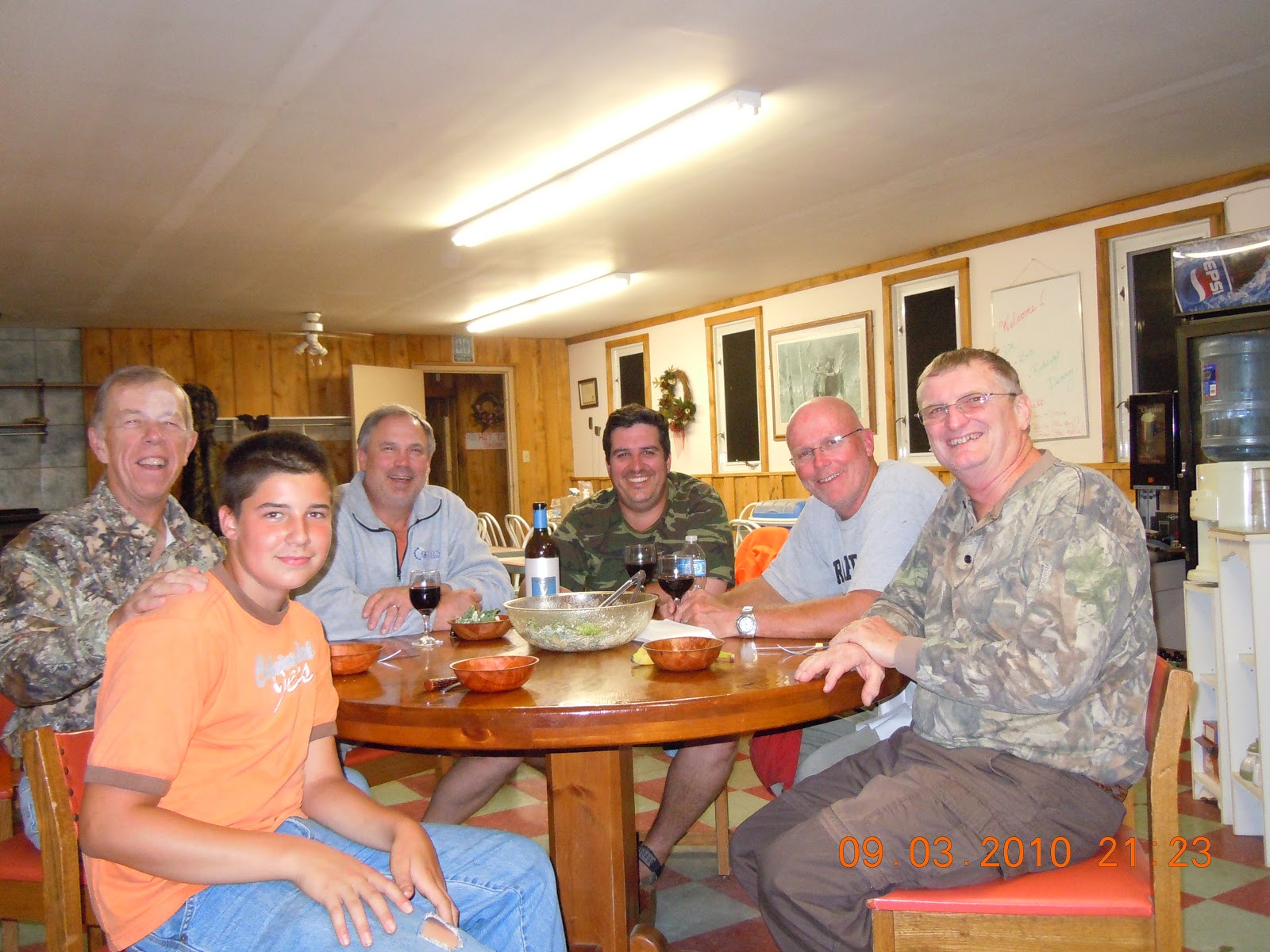
(L to R) Denny, John (the "nefu"), Jim, author, Jeff and Bob

Sharing the bounties of the chase is one of the most rewarding aspects of hunting. So, just after Jeff finished dressing my bear (see “Algoma Bear Hunt”), he set aside a tenderloin that Gail and Steve, the owners, managers and staff of “Half Way Heaven”, prepared for the whole gang the following evening.

Since I had no reason to continue to hunt for bears I spent the day with Jeff replenishing bates, checking trail cameras, looking for bear signs, and just learning anything that I could about bears, guiding and the outdoors.

By the end of the day I was as hungry as anyone and eager to taste bear for the first time, as all the other hunters, that were not fortunate enough to live in the big North woods and have bear around on a regular basis.

Gail and Steve prepared a delicious Barbecued Bear, but I prefer to call it “Bear-BQ”, and we all got together to wolf it down along a bottle of Volver, a nice Spanish red wine.

The bear was delicious, and I took the liberty to present the receipt below.

Back home, we prepared and served “Bear-BQ” on several occasions, and almost every person that tried either loved or at least liked it. But now the bear meat is finished and it may be time to go collect some more.

Barbecued Bear (or Bear-BQ)

Parboil 2 pounds bear meat (thawed & boneless, I also remove all the fat) in water, for about 10 minutes.

Prepare BBQ Sauce while meat is cooking.

Place several slices of bacon in Dutch oven, or large cast iron pan, and sauté the parboiled meat on all sides.

Add the BBQ Sauce and simmer with meat over medium heat for at least half and hour or till tender.

BBQ Sauce

·       ½ Cup of Water
·       4 Oz. Tomato Sauce
·       2 Medium Onions, sliced
·       1/8 Tea Spoon Garlic Powder
·       2 Table Spoon Brown Sugar
·       ¼ Tea Spoon Dried Mustard
·       1/8 Cup Lemon Juice
·       1/8 Cup Vinegar
·       1/8 Cup Ketchup
·       1 Table Spoon Worcestershire Sauce

Mix all ingredients and simmer for at least 10 minutes.

Saturday, September 29, 2012

Capriolo al Barolo


Nebbiolo Grapes

As a break from two weeks working in Germany attending trade shows, I took a (in my opinion) well-deserved two-day weekend in Italy’s Piemonte, with the very specific purpose of visiting my friend Vito Benevelli and having a couple meals at this restaurant Frandin da Vito.

I stopped by at lunch and we spent sometime talking (I was also eating) while Vito cleaned some fantastic Porcini mushrooms that would be the main meal during the evening’s dinner when I would return with my friend Patrick, for his proper introduction to the rich Piemontese cuisine, including proper tasting of its foremost wines, Barbaresco, Nebbiolo (which has a very special place in my soul), and the great Barolo.

Following dinner Patrick and I shared some of Vito’s Genipi (the home made liquor made of Alpine flowers and herbs I told you about before) and joined him for some discussion on Italian wines and Patrick started his collection of Great Italian wines.

Before we left, Vito asked me to comeback the following day (Saturday, 15th) at 15:00 hours (that is 3:00 PM).

Next afternoon when I arrived Vito had set aside two 12 gauge over-under shotguns and a 240 Weatherby rifle, topped with a Zeiss 8X scope, and his backpack (or Zaino) with all the gear for an afternoon hunt.

We made a stop at TAV Carignano for some Elica shooting and this time I really shot badly. If Bill Berghuiss were with us, he would have shouted “Good Shot, Dick!”

After watching our friend Signor Guido win a fat poker hand with a Straight, we bid him farewell and continued our way to Barolo, and more specifically Monforte d’Alba, Vito’s birthplace and the city were his vines and cantina are located, and the vindima was in full swing.

We visited his home and as we toured his vines I was able to taste in loco the fantastic sweetness and delicate flavor of the Nebbiolo grapes, from which both Barolo and Nebbiolo wines are made, the main difference being the aging in oak barrels, one year for the Nebbiolo and at least three years for the Barolo.

As afternoon was coming to an end, and dusk began to approach, we rushed towards a local Azienda Faunistico-Venatoria, or in US parlance a hunting preserve or lease. The property was about one thousand hectares or 2,200 acres, and was a mix of luxurious riverbeds, meadows and mature woods, and there were no fences. All game is free ranging!

All over the Barolo region I saw signs announcing that there was open hunting on wild boar and foxes, but our target was the Capriolo (Capreolus capreolus), or roe deer, one of the most widespread of the Old World deer.

We parked close to one of the gates, got our gear and started walking towards one of the several meadows that dot the property. Just as we approach it I saw a large and beautiful fox moving along the one of the edges as we passed by a large number of bee hives, another sweet wild local delicacy.

We walked towards a ditch where we entrenched ourselves, got comfortable and started waiting for dusk and capriolo. Shortly after I spotted the first deer, or better saying doe, about four hundred yards away on the opposite wood’s edge. Shortly after, Vito spotted another doe with two fawns on the opposite side of the field and less than two hundred yards from us.
Over the next hour or so we had as much as eight does and fawns at a time on the field, and the fawns were clearly demonstrating why the roe deer is capriolo in Italy. They were playing and jumping around non-stop.

A nice sized doe (capriolo is quite smaller than whitetail) came to about a hundred yards of us, and with a scoped 240 Weatherby rifle from a solid rest that would have been a very easy shot, but we were after roebucks, and never pulled the trigger.

By this time I already had realized that hunting capriolo in the Piemonte is not that different from hunting whitetails in Michigan. Big bucks don’t grow big by being stupid, and they did stick to heavy cover and never came out. When it got to dark to shoot we grabbed our stuff and walked back to the car.

We then drove back to San Mauro Torinese and Vito and I had dinner together, at his place off course! And we had Capriolo al Barolo, from an animal that he had shot some days before. We polished out a couple bottles of Nebbiolo wine and I was forced into eating dessert: small pears cooked in wine and covered with a sauce made of chocolate and Amaretto and Zuppa Inglese, which is not a soup, but a delicious cake.

Before I departed Vito committed to join me next year in Uruguay for perdiz. I will be looking forward to that.


As any regional dishes, there are many subtle ways to prepare Capriolo al Barolo. This is one that looks similar to the way that Vito cooks at his restaurant Frandin da Vito in San Mauro Torinese.

Ingredients

·       800 grams (or about two pounds) of capriolo (you could replace it by venison), without fat
·       1 large glass of Barolo wine
·       1 onion
·       2 cloves of garlic
·       1 bunch of tarragon
·       2 or 3 branches of marjoram
·       50 grams of butter
·       50 grams of white flour
·       2 small glasses of Brandy
·       1 small glass of vegetable stock
·       Salt and pepper

Preparation

Cut the capriolo in cubes, keeping the bones, and place it on a dish large enough to hold it all in one layer. Add all the wine and half of the brandy, and turn the pieces after one hour. After two hours, in a way that all pieces marinated in both sides for at least one hour, spread over all the capriolo a fine paste made of onion, garlic, tarragon, marjoram, salt and pepper (personally I do not use pepper). Leave marinating for at least four hours (my friend Vito will leave it for at least 24 hours). Before cooking, dry the pieces of capriolo with paper towels. Melt the butter over very moderate heat in a large pan (I like cast-iron) adding salt and pepper. Add the pieces of capriolo and when they are well browned in both sides, put them aside. Return all the pieces to the cooking pan, covering them with boiling water. Add the flour, the remaining of the brandy, the vegetable stock and let it cook until the sauce is reduced to gravy. Serve immediately, placing the gravy over the pieces of capriolo.

Saturday, September 15, 2012

Hasenpfeffer


Going for the safety of the hedgerow

I had not been in Europe since last May and I spent last week in a hotel in the outskirts of Frankfurt (Germany) while attending the AutoMechanika trade show.

It always surprises and enchants me how many European countries were able to achieve a reasonable balance between brutally urbanized and developed societies and keep a bit of nature, if not preserved, then at least “at hand”, even that close to major urban centers.

German is quite a green country, although most of the place has been heavily used, explored and at times destroyed by human interference for the last several hundred years, but there is an effort to landscape it in a way that makes most people feel at home when wandering through its fields.

That was pretty much the case last week. A couple mornings I went out for “a brisk walk” as recommended by my health coach, and rather than take the way to the city park, I just took “the less traveled path”.

I would start as dawn was breaking, and in a couple minutes I could leave most buildings behind and start to walk a paved trail around some agricultural fields, sugar beets waiting to be picked, wheat already harvested, and the alfalfa growing again for the last cut before winter sets in.

But what really caught my attention were the hedgerows that would shelter the fields and my trail from the frantic highways nearby. If I kept my eyes properly focused I could ignore the Frankfurt skyline and I could just pretend the unending noise of the uncountable trucks and cars could be a distant gathering storm.

It is fantastic the power of a couple meters wide un-mowed hedges. There were berry patches that would keep a black bear happy, if there were any in Germany, but above all was plenty of cover, and as the din morning light started to gain strength I started to see uncountable fluffy rabbits moving around. They were returning from their nocturnal frolics in the fields and getting back to their briar sanctuaries.

I generally could approach them to ten or fifteen yards, and very soon my wild heart started to dream of walking those hedges with a .22 rifle in hand (probably a Winchester Model 67A that I picked at a used gun rack for about US$ 140), loaded either with shorts or some of the new low noise sub-sonic loads, and the goal would be to gather a mess of rabbits for a nice Hasenpfeffer, the typical German rabbit stew, made famous by no other than Bugs Bunny himself (and infamous by some of his less charming sidekicks, Yosemite Sam and Elmer Fudd).

While I can daydream as much as I want, I am not sure how the local authorities would view my rabbit safari, especially due to the fact that I did not undergo the very stringent German hunting education program (see “Becoming a hunter…in Germany”, a post in this blog from February 15th, 2012) and would be carrying an American rifle, rather than a locally made and over-engineered one.

At one point I had to turn back to the hotel (work has a tendency to interfere with the most pleasurable moments in life), and with the morning lights much brighter now I could notice some more details. Bushes and vines were already getting tinted by the gorgeous colors of fall, red being the predominant one.

Also, the big and desirable European hares were still out in the fields, while the shy rabbits had mostly retired or were closer to the edges of the hedgerows. Apparently the hares trust their size and speed to allow them to enjoy the morning sun and are more confident to be able to outsmart or outrun the odd predator than the small bunnies.

Soon after the black crows, a protect “bird of prey”, started to fly around, tacking their murdering intensions elsewhere and completely unaware of me as a potential predator or source of danger of even nuisance.

However, I was happy to see that the beautiful woodpigeons will shy away from a person walking the fields, which indicates that some dedicated hunters still use a good load of number sixes to keep them educated and wild.

To that I must say “Weidmanns Heil” and bid you farewell!