
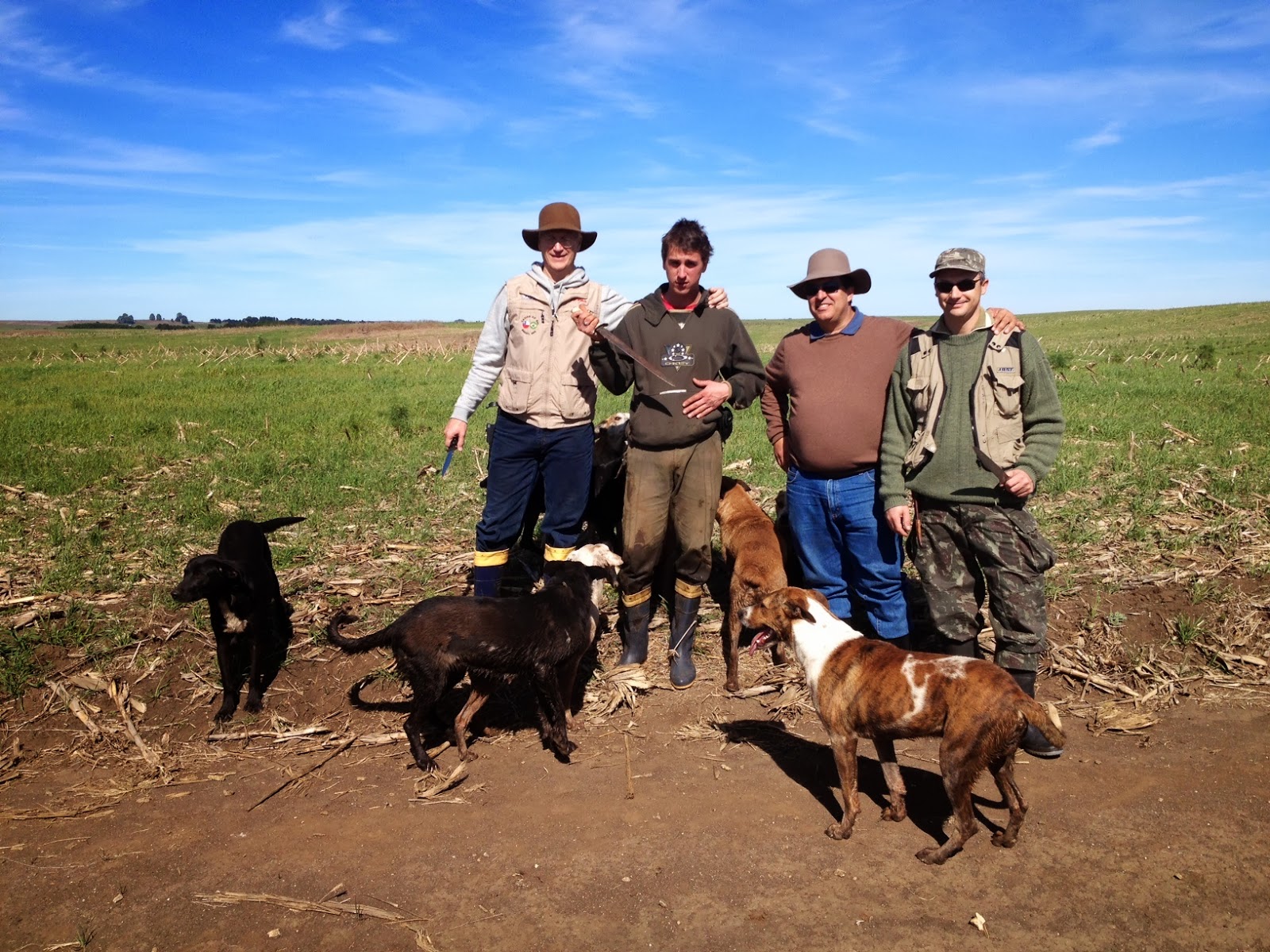
César, Tainar and his sword, the author, Ivandro
Last weekend I had went boar hunting for the first time in Rio Grande do Sul, Brazil, near the city of Bom Jesus.
It all started during a business lunch on Friday when we were having small talk and César mentioned that he was going boar hunting that night and the next day. Without any shame I volunteered to take part on the expedition, and pretty soon we had all arranged.
At 6:30 PM Ivandro and Gordo picked me up at the hotel, then we drove to César and finished loading the gear, which besides a couple 12 gauge shotguns and 308 rifles included rolled mattresses and a lot of blankets, as Brazil was facing record low temperatures.
After about two and half hours drive in tortuous single land roads we came to the 2,600 acres estância that we would hunt on, and immediately met the rest of the group, Kid and his son Tainar, and their friend Gordinho, and the first order was to uncorck some good wine, make some coppa and salami sandwiches, and of course start an almost endless exchange of tall tales and lie, which is rather typical of any gathering of hunters or fishermen.
Around 11:30 PM we went out for the first hunt, spotlighting for boar in two different trucks. The team developed a good technic: a heavy wool blanket is placed on the top of the truck cabin and secured by both back doors, and a shotgun or rifle can be safely placed on top. One spotter and a shooter travel on the bed.
When we left the temperature had dropped to just above freezing, and not fifty yards from the ranch house we saw he first animal, a graxain, which is a South American cousin of the fox that pretty much ignored our presence. Either graxains are not hunted or a very stupid.
Within the next several minutes or one mile we saw a couple lebrões (European hare) and an enormous Coati-mundi. Again, we left them untouched and continued our search for the invasive and illusion boars.
After wadding through a small river where some capybaras made their home, we came across a herd of steers that were looking for protection against the cold wind. We negotiated passage and left them behind.
At the end of our eight mile drive we came to the edges of a large swamp, and very soon located a couple of the small veado catingueiro, which is similar to, but smaller than a brocket deer. We observed one of the animals for several minutes before it decided to bid us good night and look for more private bedding grounds.
When we started back he temperature dropped to just below freezing and we made to our galpão without much to talk about. After some more wine to warm up a bit we prepared our beds and bunked in completely dressed. The wind and total lack of insulation and heating (the lone fireplace was far away) forced us to use the heavy wool blankets to cover us from feet to head.
Saturday morning we had breakfast and had the unpleasant surprise of finding Kid's pick-up truck with three flat tires, both on the driver's side plus the spare, a reminder of some of the large potholes we found the previous night. This changed plans a bit, as we had to release the hounds by the ranch house and Tainar and Gordino would walk them to the swamps where we believed the boars were hiding, and it was a long, long walk.
The younger boys led the pack of hounds throughout several swamp patches over four or five hours, while we older, and in my case fatter, gentlemen surrounded the swamp. While walking around we flushed a couple perdiz, saw some marrecas (South American teals), and admired a very large carcará hawk. Later on while I walked he edges of a swamp I first hear the unmistakable pit-pit-pit of the narceja or aguaterro, the South American cousin of our dear woodcock.
Later in the morning while crossing a part of the swamp to meet some of the guys I heard the cryptic song of the siriema, a long legged snake eating bird, that enjoys running more than flying, and could be compared to the African secretary bird.
We stopped hunting around noon when it was already warm enough not to require a jacket anymore. We gathered the dogs, but could never take a good photo with the ten all together.
Fixing the tire was a hole different story and I will not bother you with it, and on our way home we stopped at a local restaurant and enjoyed a large fresh trout lunch.
Although we did not see any boars during this hunt I was not bored at all. I had not hunted since my latest quail hunt in Alabama, back in March, and I had not seen so much animal diversity in Brasil in a long time.
I am sure that this was the first of many hunts that I will enjoy with my new friends, and saw some very large mounted hogs that are testimony to their presence in the region.
As a final note, after getting back to my hotel in Caxias do Sul I had a long hot shower, ordered some chicken and rice soup, and enjoyed a warm cozy bed for a very comfortable night.


