The Essence of Life

The Essence of Life

Friday, March 30, 2012

The Best Piece of Gear I Ever Bought

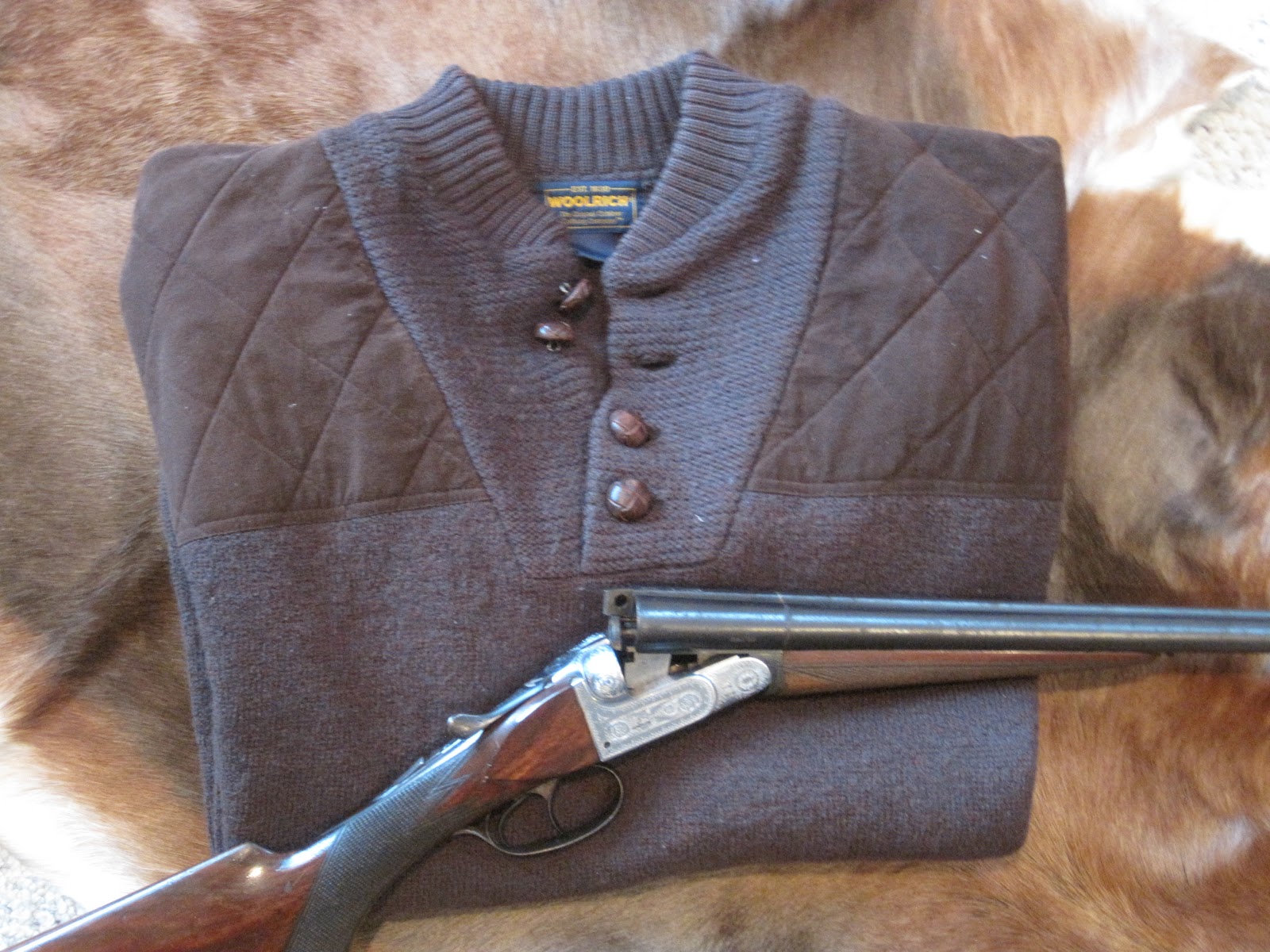
Woolrich Sweater
It is hard to deny that I am an impulsive buyer, but once in a while that pays off.
In January 2003 I attended a corporate innovation summit at the Grand Traverse Resort and Spa, and apart from a lot of snow and very long and a treacherous drive back home, a bad development program that never got anywhere, the one positive thing that came out of that trip was a new sweater.
There was an Orvis shop at the hotel, and they had a very attractive Woolrich 100% wool sweater for sale. The price was an outrageous one hundred and twenty dollars, but just after checking out I bit the bullet and bought the brownish-green or greenish-brown piece of clothing and took it home with me.
Almost ten years later, this sweater, that I am wearing as I write this words, is probably the best and most useful piece of gear that I ever bought. I used it to hunt in Michigan, North Dakota, Arkansas, Ontario, South Africa and Uruguay. It is absolute quiet, warm even when it is wet, so well cut that it can be used in social occasions (although it is starting to show signs of age and some damage from brush and brambles).
Along with my Swiss Army Knife (about which I will talk in the future), I don’t think that there is a piece of gear that I ever used more than my Woolrich sweater. The only problem with it is that it is no longer available.
As Gene Hill once mentioned in one of his books, anytime we find a very special piece of gear; be it a hunting jacket, a pair of boots, or a sweater, and we fall in love with it, it goes out of catalog and we will never again be able to find a replacement.
I recently bought another sweater from Orvis; it is a nice Beretta green wool with windshear lining. While it may complement my old Woolrich, it will not replace it.

P.S.: The shotgun in the picture is a little Beretta side-by-side 28 gauge that my mother bought to my father as a wedding gift. This is the gun that my son used to shoot his first bird on the day of my father’s funeral. I tell this story on the very first posting of this blog “Last Bird, First Bird”.

Monday, March 19, 2012

How I Got Started in Wing Shooting

Photo by Aluísio

 
I was raised on a farm in Northern São Paulo state in Brazil and a day in 1976 we moved to town so I could attend school since there were no school buses and the sixteen miles of dirt roads were in many cases impassable during heavy rains.
We continued to come a lot to the farm, for weekends and vacations, but as the years went by, the house built in 1954 started to show signs of age, especially the old wooden windows and particularly the one in the “boys’ bedroom”, and no matter how you tried to close it, there was always some crevice or opening left.
So, it became very common for us to find bats in our room, and that was always a great time to train anti-aircraft artillery. We first closed the door so the grown-ups would not be aware of the intruder, then stuck a pillow into the gap of the window, removed our shoes and started to throw them at the bat.
Needless to say that since shoes do not have proximity fuses or the pattern capabilities of good shotgun shells it took a lot of “rounds” to bring the flying rats down, and after many such battles the ceiling got a lot of permanent marks from the mud and cow dung in our boots.
Next came a CBC 310 (8 mm rim fire) single shot shotgun. Although I shot mostly birds, I used the little gun almost as a carbine, as I stalked my prey as close as I could to make sure that the small charge of No. 12 shot hit its target (the most covered of which was the big white-winged pigeons or Asa Brancas (Paragioenas picazuro)), and that probably would not qualify as wing shooting.
If I remember correctly the first bird that I ever shot on the wing was a quero-quero (Vanellus chilensis) during a July vacation in our farm in Goiás state, central Brazil. As I walked along a two-track in a field the bird started to fly over, probably trying to protect its nest, and when it was floating on the wing I shot it with a 28 gauge side-by-side shotgun. I examined it and found that the quero-quero has spurs on its wings, and then left it behind. The next day I only found some feathers, and felt less bad for having provided a meal for some poor scavenger.
Not until after I got married I shot a couple rounds of trap and some friends allowed me to use their reloading presses to make some proper shells, plastics hulls and wads and 11/8 ounces (32 grams) of 7½ shot. If I remember one thing in particular is that those shells kicked much harder than the calves we had in the corral.
Things really changes when we relocated to Michigan and by accident or fortune we bought our home less than five miles from the Southern Michigan Gun Club outdoors range, and I started shooting skeet and buying new shotguns on a rather regular basis.
From my humble battles with bats, I have now hunted birds on the wing in Brazil, Uruguay, South Africa, Michigan, Indiana, North Dakota and Arkansas, and currently I regularly shoot clay pigeons in Michigan and Italy, but I must say that almost nothing that flies compares to the big white-winged pigeons that come just before sunset to roost in the giant bamboos of a certain farm in a poor country where all hunting is outlawed.
Even with all the opportunities that I currently have, another day I was almost homesick when my mother told me that my nephews had their first encounters with bats at the farm house. Poor kids, their shoes probably do not fly as well or hit as hard as my brother’s orthopedic boots.

Saturday, March 17, 2012

Short Traveling Notes

Piazza Solferino, Torino
I am back in Europe, hunting new business, but I am never very far away from real hunting.
I brought two books in the trip. Kuki Gallman’s “Sognavo L’Africa” (I Dreamed of Africa), which I finished yesterday, and Bob Munger’s “Trailing a Bear”, that describes his many trips and adventures with Fred Bear. I already had watched the movie “I Dreamed of Africa” and read the book in English, but I picked the Italian version on a street market some weeks ago in order to help me improve my Italian grammar and vocabulary.
On Thursday we traveled from Baden-Baden to Frankfurt by car and besides the ever presented elevated hunting stands (in a small field I counted five!), I saw a beautiful colorful rooster pheasant at the corner of a plowed field, and not ten minutes later a saw a Roe buck with nice antlers walking across a field parallel to the tree line.
On Friday, coming back from Tczew to the Gdansk airport I spotted a larger deer, probably a red stag hind still wearing its grey winter coat not too far from the highway.
Finally, today I had lunch at the Cantina Barbaroux in Torino. In their menu they say that this is longest continuously operated cantina in Torino, established in 1902. The main dish was “arrosto di cinghiale con polenta” (roasted wild boar with polenta), and it was good enough to lick the plate, or almost. I used some bread to savor the last drop of sauce and juice.

Thursday, March 8, 2012

The Most Flexible Gun


Remington 870 Express


One of the first things that I learned when I started my engineering degree is that we should not become a specialist that could only solve one type of problem, nor be a generalist that could not solve any problem well. In order to be successful we need to achieve a certain balance, be the expert in some areas, but have good level of knowledge over a broader field of our activities.
In many ways, this rational also applies to most fields of human activities. A Formula 1 car is only good to race inside a track, and if you try to use one to take your groceries home you may face some major issues. On the other hand, an average mid-size sedan is a much more flexible vehicle and will better meet the needs of a greater number of people.
Guns are no different and some firearms are so specialized that they only perform well in certain situations and are in many cases impractical for almost any other use. Examples of ultra specialized guns are free pistols, which are single shot .22 LR open sighted handguns with a extremely light trigger and no safety, a dedicated American Trap single shot shotgun with a release trigger (and no safety), or a large bore (e.g. .450” and up) double barrel express rifle. While each of these guns excel in their specialized application, like the Formula 1 car, they are not much good for almost any other use.
But there are some guns that are much more utilitarian, and although they may not be the best for certain specialized or eccentric needs, they are will perform a large number of shores exceedingly well.
I hunt birds as well as large game, enjoy “clay pigeon” shooting a lot, like to shoot for fun, and believe that it is a good insurance policy to keep a firearm for home defense, although I hope that I will never need it for the last purpose.
I also have many different guns that I can choose for each different shooting discipline or hunting condition that I am likely to face, but many times a question comes to me: what if, by some terrible force, I had to live with only one gun? Which one should I choose?
The traditional answer for this question generally takes us to central Europe, or more specifically Germany and Austria, where combination guns have been popular for as long as one can remember. These guns may have two, three or even four barrels, and as a rule combine at least one smooth bore and one rifled barrel, thus allowing the hunter to hunt large or small game, and shoot game on the wing or at several hundred meters (remember, these are European guns and they only understand the metric system).
While these combination guns are certainly flexible, they do have some drawbacks. First they are expensive, in general very expensive. Second, they tend to be a bit heavy and cumbersome. Third, they tend to be mechanically intricate, or in simple words they follow the old German axiom, why make things simpler if you can make then complicated and they still work.
Finally, and due to the third point, too many things can go wrong with complicated systems, especially operator error. I have read and heard too many stories about pushing the wrong button, sliding the wrong lever, or pulling the wrong trigger and setting the wrong barrel off. The typical results are shooting a pheasant with a 9,3x74R mm bullet, or a jaguar or eland with a load or bird shot, which is at least a bit annoying.
My approach for a very flexible gun is not particularly high tech, and many would consider it almost mundane. It is very affordable or almost inexpensive, very handy and extremely simple.
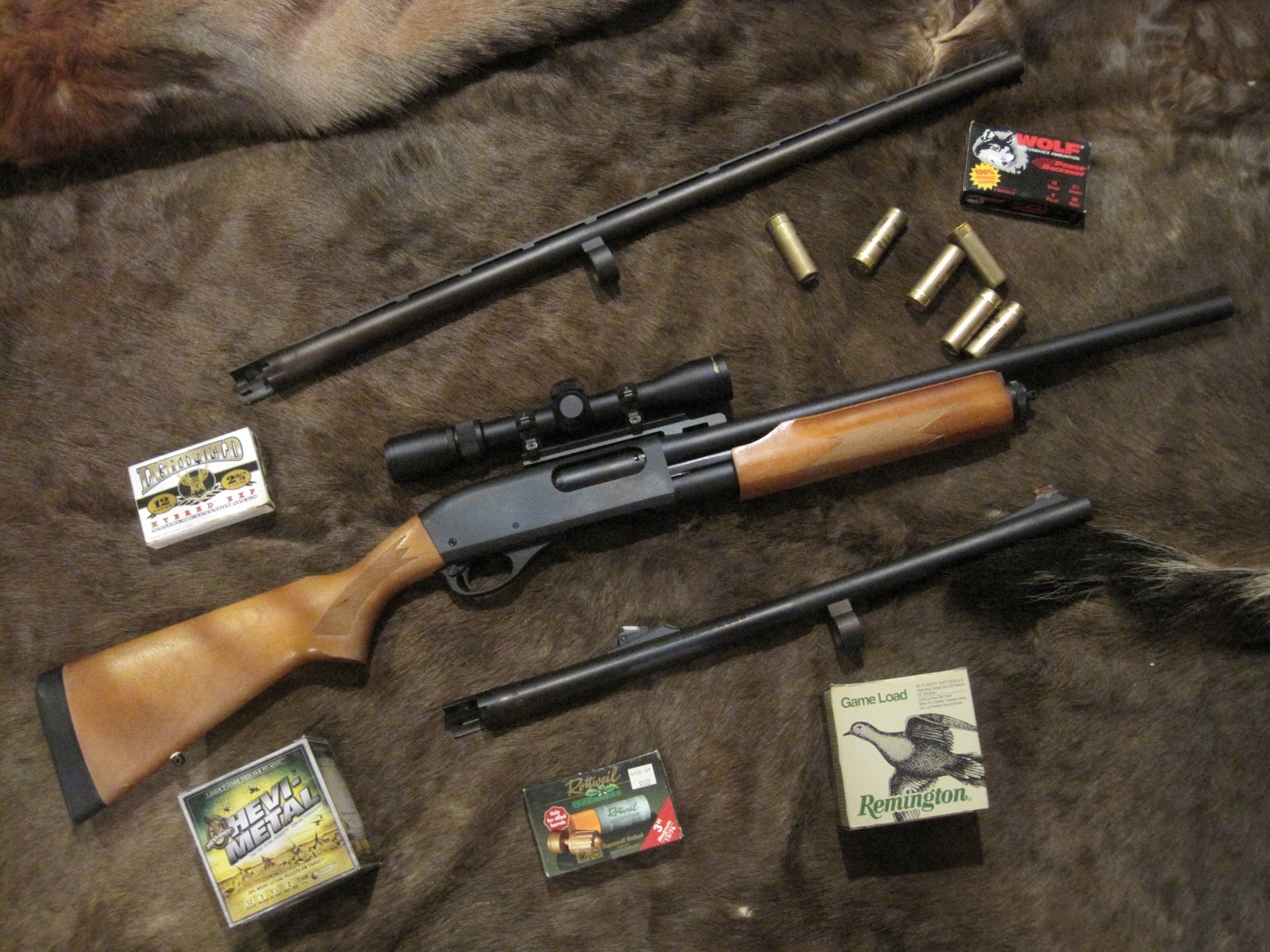
As you already guessed from the picture above, I choose my 12 gauge Remington 870 as my most flexible gun. Besides the inherited flexibility of shotguns (just pick the right ammunition and they will get the job done), the 870 pump action design and easy to change barrels allow it to perform very well under very different situations.
The short 18½” (470 mm) barrel combined with the five shot capacity and fast pump action provide me with one of the best home defense gun that has even been conceived. The same or similar set-up has been used for police and military work for over a century, and although we will find new “combat shotguns” with a lot more features, the Remington 870 is still the standard against which all others are measured against.
The same short barrel, either loaded with buckshot or Brenneke slugs, makes a wonderful gun to hunt in heavy bush or swamps. You could be after wild boars, deer or even a wounded leopard and not be under gunned.
Then there is the 23” (584 mm) fully rifled cantilever barrel. In my case it is topped with a Nikon ProStaff 2-7x32 scope, and the only ammo I shoot through it is the Lightfield Hybred EXP slugs. I shot deer at over 140 yards with this combination and I believe that it can be pushed a bit farther. The 546 grain 12 gauge projectile with 2,549 ft./lbs of muzzle energy makes this round capable of taking almost any game in the world, the few exceptions being buffalo, rhino, hippo and elephant. Although not ideal, the 870 with its slug barrel could be used as a “battle rifle” or even as mid-range varmint gun.
Next comes the 28” (710 mm) ribbed barrel with screw in choke tubes. This is the barrel that gets the most use, as it is used for small game, upland birds and waterfowl, and skeet, trap, five-stand (Compaq), sporting clays, and any other form of shotgun games. It is also the most flexible of the three barrels that I have, and the one that I would pick, if I was forced to just one barrel, as it can shoot bird or buck shot, slugs and almost any thing that fits inside it.
There are other guns in the market that could be as flexible as the Remington 870, but to my tast, the 870 delivers the best value and handling of all of them.
It is great to have options, buy, sell and trade guns now and then, day dream about new adventures and choose which gun to use for each different activity. On the other hand, it is reassuring to have one good “go to” gun. That most flexible gun that you know will get the job done.

Sunday, February 26, 2012

The Value of a Trophy

A Mythical Unicorn?
I am in Torino in this gorgeous Sunday morning. The sky is blue and the air is warming quickly. Spring is in the air! And, for the last several days it has been difficult for me to put the time aside to write a new post, but here we go.
People hunt for several reasons. Some for food (subsistence), others for profit (poaching), and a few because they need to prove something to themselves, but most of us I believe hunt because as Ortega Y Gasset said “men are fugitive from nature” and therefore we hunt to have a “vacation from our human condition.”
To most hunters the act of hunting is the biggest prize that we could have, and Robert Ruark put it perfectly that “the best part of hunting and fishing was the thinking about going and the talking about it after you got back.”
If we consider the above, a trophy is not really required to make hunt unforgettable. However, a trophy is something tangible that allows us to revive the experience and talk about the hunt many years, sometimes decades, after it took place, but it took me sometime to understand that.
To illustrate that, I would like you to read two excerpts from my book “A Wild Beast at Heart.”
------------------------------------------------------------------------------------------------------------------------------
From “Opening Day”
By first light the fusillade almost made me think I was in Iraq or some other part of the world not as nice as Michigan and I started seeing something white across the field, but it was nothing more than some paper taped to a pole. Around eight, I missed, just missed, a very nice buck running at 60 or 70 yards. But since I was quite comfortable in my blind, I endured.
Nature was forgiving to me. Around nine, a nice sized buck came walking about 40 yards, directly in front of me. I took my time, put the cross hairs to his shoulders, kept moving my shotgun like on a very slow “high house” clay pigeon, and could see fur coming out of him when he was hit, and before he took off.
After a quarter of an hour or so we started trailing him. Bob was the first to find the blood spoor and we located the buck about a hundred yards into the trees (but it felt like a mile after I had to drag him) and for one moment I felt as being robbed of something. The left antler was crooked, twisted downwards and just barely attached to the skull skin. At once I remembered Robert Ruark’s “The Horn of the Hunter”, when after trailing Kudu for several days or weeks, he shoots this prize bull only to find out that he was an immature animal with only one curl in his horns. But this feeling only lasted a moment.
I drove home and brought my family back, so my kids could see that beef (or venison for the matter) doesn’t come from “Meijer’s”, and took the rest of the day butchering and packing the meat. I could say that this story ends at Christmas Eve tasting the very well prepared venison ham, but no. Those unimpressive antlers will keep bringing me back nice memories, especially of friendship. Thank you, Bob.
------------------------------------------------------------------------------------------------------------------------------
From “The Winterberg Journal”
As we continued trailing, uphill, Munguezi, our tracker, spotted a bushbuck, one of Africa’s most beautiful antelopes. We scouted this particular animal for almost two hours before I could take a shot. Up and down hill, closer and farther, the sun shining on my rifle barrel and turning my scope in a perverse flashlight. We lost him in the bush until a young kudu bull spooked by Frans made him move again.
I shot my bushbuck at about 170 meters (or yards, who cares?) and he went down, out of sight. As the light was starting to fade Frans asked me to go along with Munguezi while he covered the general area with his rifle in case the animal tried to escape while we approached him. Frans was kind enough to remind me that bushbucks are very dangerous animals that will often charge when wounded.
Again, the approach was very exciting but we had to climb down a hill and climb up another before we reached the area the animal was when shot. We found the animal, dead from a fatal, if somewhat misplaced, neck shot. And disaster struck me once more. This absolute huge bushbuck, 15 and 1/5 inches horn length, suitable to ingress in the prestigious Rowland Awards big game record book, had a single horn, the missing one broken at the base.
My heart and soul are twisting at this moment. What to do with this magnificent animal? I need to think.
------------------------------------------------------------------------------------------------------------------------------
In Africa, our professional hunter, Frans Bussiahn (http://www.mankazana.co.za/) had said that if were told by one of the PH’s to shoot an animal that was not a trophy animal, then we could shoot an additional animal of the same species at no additional cost. True to his word, be immediately made the offer for another bushbuck, but he said that I could only keep one of the trophies.
I should have remembered the story of my own first whitetail deer, but after some thinking I decided to hunt another bushbuck to have a nice representative specimen with both horns.  While it was great to hunt a bit more, getting the second bush buck was not as challenging as the first and almost anticlimactic, and although it made a very nice mount, in my mind it lacks the majesty and mystery of the green-eyed unicorn that I shot on my first day on safari.

Wednesday, February 15, 2012

Becoming a Hunter...In Germany

Wild Boar at the entrance of the Deutsches Jagd- und Fischereimuseum

We all know how hard it is to become a new hunter around here (here being Southwest Michigan, USA). If you were born after January 1st, 1960, you will need to get a hold of Greg Anderson or other Hunter Safety instructor and sign-up for a course that may consume two full Saturdays and cost you ten dollars. Greg will feed you very well on those two days, but most people will complain about the price. Then you will have to take a test that most children twelve and older will pass, but again, you may complain.
After that you will receive a Hunter’s Safety Card, and you can go to any of the thousands of retailers that sell Hunting & Fishing licenses and complain again for paying fifteen dollars for a “small game” or the same amount for a deer or turkey license. For waterfowl you also need to buy a Federal Duck Stamp for the princely sum of twenty dollars.
Finally, if you don’t have access to a private property, you may have to call the Department of Natural Resources (DNR) to receive, free of charge, maps for thousands of acres of public land all over the state. But again you will complain that public land is too crowded and there is no good hunting there.
Well, in order to make us Michigan (or most American) hunters feel less miserable I had a long conversation with my friend Thomas Fritz, who lives in Southern Germany, and is currently in the process of becoming a hunter, which off course includes getting his first German hunting license.
The odyssey is more or less like this: first you decide that you want to become a hunter, and then you find a way of setting time aside for the four to six months required to complete the course.
A minimum of one hundred and thirty hours of theory are administered on Mondays and Thursdays (two hours each evening), and on Saturdays you will have field activities, shooting lessons and veterinary training in order to identify potential illnesses in the game animals or its meat.
After that you will take a written test on the following subjects: animal natural history & health, hunting practice, forestry & farming, hunting dogs, and hunting & firearm laws.
Then you will take a shooting test that includes:
·         Handguns (although German law prohibits hunting with handguns, they may be used for “coupe de grace” or dispatching wounded or trapped animals);
·         Shotguns: a minimum of 150 clay pigeons (but not shot on a single day), and 10 rabbit targets. The hunter must hit at least half of the targets;
·         Rifles: five shots from bench at 100 meters (must hit 9-ring or better) and five shots off-hand at “running game” (must hit 5-ring or better). In both cases, the three best shots count for score.
Finally there is an interview or oral test during which the “hunter-to-be” must be able to identify several animal “parts” and if approved in all tests the person can now apply for a hunting (and also trapping) license. The cost up to this point is about three thousand Euros or about four thousand dollars.
At some time during the process, it is necessary to become a member of a hunting club or society, and along the duration of the course, the “hunter-to-be” can be a beater on drives or even gut animals under the supervision of a licensed hunter, but he cannot handle firearms. Actually he cannot purchase firearms or ammunition without the hunting license.
The cost of the hunting license is ninety Euros (about one hundred and twenty dollars) and is valid for three years; however there is no public land available for hunting, and therefore it is pay to play. Either the hunting club has a leasing, or the hunter pays for each animal. A deer typical cost is three thousand Euros (four thousand dollars), while boars are much less due to overpopulation.
One of the alternatives to make hunting costs more manageable is to sell the game meet, which is legal in most of Europe, and this is one of reasons that animal health is one of the required subjects of the hunting course.
Similar to the United States, Germany is facing a declining on the number of hunters and the complexity and cost associated with new hunting licenses is probably one of the reasons. One of the consequences is that ungulate wildlife (deer and boars) is on the rise throughout Germany with associated damage to the environment (over browsing) and crop depredation, and foresters are requesting hunters to shoot as many deer and boars as possible.
If you are willing to volunteer to control the Germany wildlife population, foreign hunters can apply for a limited term (14 days) license, but Thomas was not aware of the specific rules. But even as volunteer you may have to pay your own way.
Different countries have diverse and very particular culture, and one is not inherently better than the other, but just different. The point is that many times it is difficult to appreciate what we have without parameters for comparison.
From what I could learn while traveling the world, talking with friends and researching the subject, the North American wildlife conservation model is the most inclusive and affordable in the world. Let’s cherish that.

Friday, February 10, 2012

Virtual Hunting II

Giant Irish Deer (Megalocerus giganteus)

A couple weeks ago I had a brief “tour” of central Europe on another business trip and was lucky enough not to have any travel disruptions due to the brutally cold weather.
I really believe that the atavist passion for hunting still pulses very strongly inside the human soul, even if the rather thin varnish of a contemporary and almost metrosexual civilization tries to deny it.
On the first night in Gdansk I ordered a great wild boar dish, a fantastic roast complemented by forest mushrooms and wild berry sauce. A good Argentinian Malbec enhanced the awesome dish.
My choice of a “wild game” dish brought up a discussion about hunting and my undisguised passion for it. And most people are at a minimum curious about hunting and after a bit or a lot of conversations I generally find out that many people are very supportive of hunting, both as a sport and as a wildlife management tool. And as more people got engaged in our conversation it became apparent that many of them had either hunted, knew someone or had a relative that did it, or have an interest to do so.
A couple days later I came to Munich for more business meetings. On the way to a meeting in Dachau while driving at an Autobahn and close to the Munich International Airport I saw a small deer herd appreciating the warm sun on the bitterly cold morning. They were at a tree line, exactly under an elevated shooting platform and just a couple days after the season closed. Apparently deer in Germany know the calendar as well as those in Michigan.
On the way back I saw several large European hares peacefully sunning on a stubble field.
Besides that I did two very nice things. First I had a very nice discussion with a colleague, Thomas, who is in the process of getting a German hunting license. This is a long and somewhat complex process and I will describe it in detail in the near future.
Second, I had the opportunity to once again visit the DEUTSCHES JAGD- UND FISCHEREIMUSEUM (www.jagd-fischerei-museum.de) in Neuhauser Strasse 2, downtown Munich.
The museum is very nice and as the name implies it is dedicated to the German hunting and fishing culture, mainly from the XVII to the late XIX centuries, and also to the natural history of the main animals that are pursued there.
On going up the first flight of stairs we are greeted by Diana, our goddess, peaceful and permanent in brown marble. As I was admiring her I called my wife and we had a brief discussion about real women and their curves, so well represented by the statue, and not like many of the “unreal” plastic surgery altered contraptions that the media tries to sell us nowadays. There is nothing wrong with small breasts, a nice tummy and good hips on the women we love.
The main hall on the second floor was mostly under renovation, but it has two features that are worthwhile mentioning. One is an interactive series of displays focused on children, as they can touch and feel the different mounted animals and allow them to develop a much deeper appreciation for the animals than by only looking through a glass window. Some of the mounts show signs of wear and tear, but that is what it is all about.
A couple steps from there, on the way to the floor’s main hall there was one of the nicest use of digital technology that I ever saw: a virtual trout stream.
Besides the calming sound of running water the stream and all its elements, from falling leaves to large brown trout, react to our presence, or better our intrusion. When we step on the “stream” ripples disturb its surface. As I tried to approach the large trout they would either hide under the banks or swim away. I felt like a child and could have played there for hours.
There was also a film on how hunters interact with the environment and are a critical factor on its sustainable use.
As a rule, we hunters tend to talk a lot among ourselves, but we do not spend enough time promoting the sport and recruiting new disciples of Saint Hubert.
The value of places like German Hunt and Fishing Museum add to our need to continue to educate non-hunters in order to maintain the social acceptability of hunting and fishing is absolutely great. In order to have a future we all need to promote hunting as a health, safe and relevant activity.