The Essence of Life

The Essence of Life

Monday, September 16, 2013

Algoma 2013 - Day 2: More than Grouse

A moose visiting a bear bait


Today we had a lazy start following a very nice breakfast. Bob and I went checking some bate sites, but none had been hit.

On the way to "Bait 17" Bob saw a grouse and I almost had to kick it before I could shoot it in a more or less sportive way. I was a cock spruce grouse and I think it will it very well along its also deceased relative from yesterday.

We came back and had lunch and went separate ways for our respective baits. It was almost warm when we left, but by mid afternoon the temperature started to drop and by the time I got back to the truck around 8:00 PM it was down to not so warm 36F.

There is a full moon and not a cloud in the sky, so we should have another frost tomorrow morning, and definitively I will wear my under armor.

When Bob got back about 20 minutes after I arrived he was excited for having had a very close encounter with a bull moose while riding his ATV. We all gave him a hard time for not taking a picture while both, the moose and him, sped along a narrow logging road.

I reminded Jeff that when I was here for the first time three years ago I shot my bear the first afternoon after less than two hours hunting. Considering I hunted for about six hours, I already should have shot three bears.

Let's see what tomorrow brings...

Sunday, September 15, 2013

Algoma 2013 - Day 1: GROUSE!

Spruce Grouse and BSS

Following some planning and a lot of expectation my friend Bob Scott and I are again hunting bear with Jeff Helms of Agawa Canyon Outfitters (www.trophybears.com). We left my home in Traverse City at 5:30 this morning after attending the Ruffed Grouse Society banquet yesterday, and after crossing the Mackinaw and Sault Saint Marie bridges and driving the eastern coast of Lake Superior until Wawa from where we headed to Halfway Heaven in the Algoma sustainable management forest, where we arrived by mid afternoon and we immediately met Jeff, and the Halfway owners Gail and Steve, and soon after we met Joseph who came for a week of fishing and kayaking.

As both Bob and I where tired due to the short night and long drive we decided not to hunt today and went out with Jeff and Joseph scouting and baiting five or six different sites from where we will hunt during the week.

We found evidence of bear activity in all but one of the sites, and a trail camera confirmed the presence of a very large bear in one of the bait sites, and although we were not hunting bear I took my 20 gauge Browning side-by-side shotgun (BSS) just in case we would need better protection that the bear spray that both Bob and Jeff were carrying or in the case that we would come across some grouse, as I had never had the opportunity to hunt these awesome birds before.

After going all the baits Jeff drove us to a covert just by the roadside and after struggling around the dense forest for a while Bob, who earlier had volunteered to play pointer, flushed two birds. I hit one with the second barrel as it was about to reach the top of a tree. After I retrieved it Joseph spotted the second bird not ten fit above the ground on a pine. I saw the bird and could have easily killed it, but instead I flushed it, not without some effort and missed as it flew away and put not one tree, but half of a forest between us.

We tried to locate more birds but did not succeed, and as dinner time was already past we drove back the Halfway where Steve positively identified the bird as a female Spruce Grouse, the first bird of this species that I ever shot.

We enjoyed a bottle of Veo Grande, a good Chilean Cabernet and continued to talk hunting, fishing and related lies.


Friday, September 6, 2013

A 30-30 For All Seasons

Savage Model 219

It is a fast world out there with an unrelenting pace, but between all my air travels, all the talk about the “Modern Sporting Rifle” (which I sometimes shoot) and endless apocalyptical TV shows that almost ways feature zombies (which I never watch); I try to find ways to disconnect and chill out. And in order to chill out I do very little fishing, almost as little kayaking, a lot of reading, mostly about hunting, hunting whenever I can, and shooting, shotguns in bearable weather, air guns in unbearable weather (too hot, too cold or too wet don’t affect my basement), and unusual rifles on rare occasions.

Earlier this year I attended a gun show in Novi, Michigan, and among the multitude of modern firearms I found an unusual rifle that not only attracted my attention, but also my wallet. Please, don’t tell my wife. She will be mad!

That rifle was a Savage Model 219 in 30-30 or 30 Winchester Center Fire, and rather than trying to describe it myself I will quote from the 1940 Shooter’s Bible (Authentic Reproduction) where it is portrayed on page 35 under SAVAGE COMBINATION RIFLES AND SHOTGUNS:


MODEL 219 SINGLE SHOT RIFLE

Calibers .30/30, .32/20, .25/20 and .22 Hornet

Tapered, medium weight, round barrel with raised front sight base, length 26 inches. Proof tested. Barrel and lug forged in one piece. Hammerless action with Automatic Top Tang Safety. Polished and blued frame. Barrel bolted to frame with large beveled locking bolt. Forearm fastens with tension of heavy steel spring against hinge pin and forearm barrel lug. Both features designed to automatically take up wear. Selected American Walnut stock and forearm, full pistol grip stock with fluted comb. Hard rubber butt plate. Sights, adjustable flat top rear sight. Bead front sight. Weight about 6 pounds.

Model 219……………………………………………….......................…...………Price $15.00


A number of factors attracted me to this little rifle. First, I always wanted a 30-30 gun, but while I really like the Winchester Model 92 I can’t say that I have the same feelings for the Model 94. Second, I have a great appreciation for the concept of the British Rook and Rabbit Rifle, which is basically a gentle, light, single shot, center fire “small bore” rifle used to either hunt small game or control pests. And finally, the Savage Model 219 would make a nice platform to shoot my BS loads.

BS may stand for Basement Special loads, Buck Shot loads or other less polite terms. They are squib loads for high powered center fire rifles that allow them to be safely and comfortably used almost any where that you have a safe backstop that will stop a .22 rim fire bullet. The basic recipe for my BS loads is a 1½ buck shot (the .310” diameter round bullet fits about perfectly to 30 caliber rifles) sitting on top of a two to three grains of fast burning shotgun or pistol smokeless powder and a standard rifle primer. (Disclaimer: This load is safe on my gun, but I cannot accept any responsibility for it being used in other firearms.)

I already discussed similar loads using chamber adapters and 32 pistol brass in the past, but this time I wanted to make them even simpler (actually cheaper, since the adapters cost around US$ 20 each), so I just resized some 30-30 brass, put a new primer in place, poured 2.5 grains of Universal gun powder in it (an spent .22 LR shell makes a good measure), and hand sat a single 1½ lead buck shot as a bullet. It takes longer to describe the process than to make a BS center fire load.

The result is a perfectly functional all-American Rook and Rabbit Rifle, with minimum noise and no recoil at all. The load above propels the 46 grains “bullet” at about 700 feet per second producing minute of squirrel or minute of rabbit or minute of crow accuracy to about 30 yards. If you need to shoot farther just add a little bit more powder. Back in Brazil this Savage 219 in 30-30 could be used to hunt any and all game existing in the country, with the exception of feral water buffalo.

One of the virtues of single shot rifles is that you can feed them just about any load or bullet that fits the chamber. There is no repeating mechanism to worry about or malfunction. If the BS load is a bit too light for your needs, 30 caliber rifles are blessed with an almost limitless selection of bullets, from 90 to 250 grains. Besides the BS loads for small game, this little Savage Model 219 will be shooting high performance 130 grain soft points during the November Michigan whitetail deer season.

The take down and lightweight design my even allow it to travel with me down to the rather long and generous Alabama deer season, and maybe it also has the opportunity to prove itself on the local feral hogs.

If I ever stop traveling, I may also use it for cottontails, bushy tails or an unwelcome crow during the winter months. As for the remaining of the year, it is polite enough to be used in my basement or backyard.

Minute of soda pop accuracy, plus empty, BS load and 170 grain shells

Wednesday, September 4, 2013

A New Generation

Maria Eduarda & Sylas

My first grandson, Sylas Meirelles Mulder, was born yesterday at 5:29 PM US EDT at the Munson Medical Center in Traverse City, MI. At birth he weighted 2.932 Kg and measured 53 cm.

As his first gift he received a custom made friction folding knife that was commissioned by my father several years ago. The blade is hand forged from a diesel engine valve and the scales are from the antlers of a Michigan whitetail deer that my friend Bob Scott found dead by the roadside and gave to me.

Every man should have at least one good sharp knife as it is the one tool that will never become obsolete, and although Sylas will never have the pleasure of meeting his great grandfather Tuim, he already has a unique gift to treasure his memory, not to mention the hunter's genes.

Please, join me in welcoming the new hunter's generation.

Tuesday, August 13, 2013

Parabellum

Artillery Luger with holster and attachable stock

There are few firearms are so easily recognized, admired, coveted and evoke mystery as the Parabellum or Luger self-loading pistol. Its superb ergonomics, intricate mechanics and luxurious bluing, so out of place in a military service sidearm, completely sets it aside from myriad other guns.

Its sensual lines and dark skin reminds me much more of a beautiful and mysterious middle-eastern or South American femme fatale than of an athletic and blond German fraulein, while the steep price tags and relative scarceness may bring to mind a Parisian exotic dancer.

An although primarily a military weapon adopted by many countries in the early XX century, which would probably make it the Glock of its days, I really like the Parabellum because it was never out of place in many other environments, be it Cinema Noir, pulp mysteries or the great outdoors.

I remember reading an article from the great Jack O’Connor where he mentions a relative that used a .30 Luger to shoot desert big horn sheep, but two of my all time favorite mentions to the Luger come from classic books from the early decades of the XX century. I researched Theodore Roosevelt’s Through the Brazilian Wilderness to write a feature The Guns of Doubt that was once available at Amazon Shorts, and the other is Beryl Markham’s West with the Night, and I present extracts below to illustrate how the desirable Parabellum self-loading pistols transcended battle fields and morphed itself into both hunting and survival firearms.

“The last gun of notice of the American team is Kermit’s Luger, which he uses to shoot birds and small game. Although as in the previous case, the gun specification is not clear, we know it had a detachable stock because Colonel Roosevelt refers to it in a passage as a “belt carbine”. There are also strong evidence that this particular Luger was a pistol chambered in 30 Luger, or 7,65 mm Parabellum with barrel length around six inches, instead of the Model 1902 Carbine which had a much longer barrel, around 12 inches, with a forearm and a much more elaborated detachable stock.

The reason for the conclusion above is that Mr. Fiala mentions in the Appendix B of Through the Brazilian Wilderness that ‘a 25 or 30 caliber high-power automatic pistol with six or seven inch barrel would prove a valuable arm to carry always on the person.’ He goes on describing the several possible uses and advantages of having such gun, including the need to carry several loaded magazines, but he strangely complains that ‘there is nothing in the market of this character.’

A strong reason for always carrying the pistol on the person is that Mr. Fiala, who took a different route than the main body of the expedition before they went down the Rio da Dúvida and into the Green Hell, lost all their guns in a canoe accident and had serious problems in securing food through hunting.”
Rodrigo Meirelles – The Guns of Doubt

“Meanwhile, haven’t I got two quarts of water, a pound of biltong — and the doctor’s bottled sleep (should I be hors de combat and the Siafu hungry that night)? I certainly have, and, moreover, I am not defenseless. I have a Luger in my locker — a gun that Tom has insisted on my carrying, and which can be used as a short rifle simply by adjusting its emergency stock. What could be better? I am an expedition by myself, complete with rations, a weapon, and a book to read — Air Navigation, by Weems.”
Beryl Markham – West with the Night


Maybe a day I will have a Luger in my haversack.

Tuesday, July 30, 2013

Boaring...

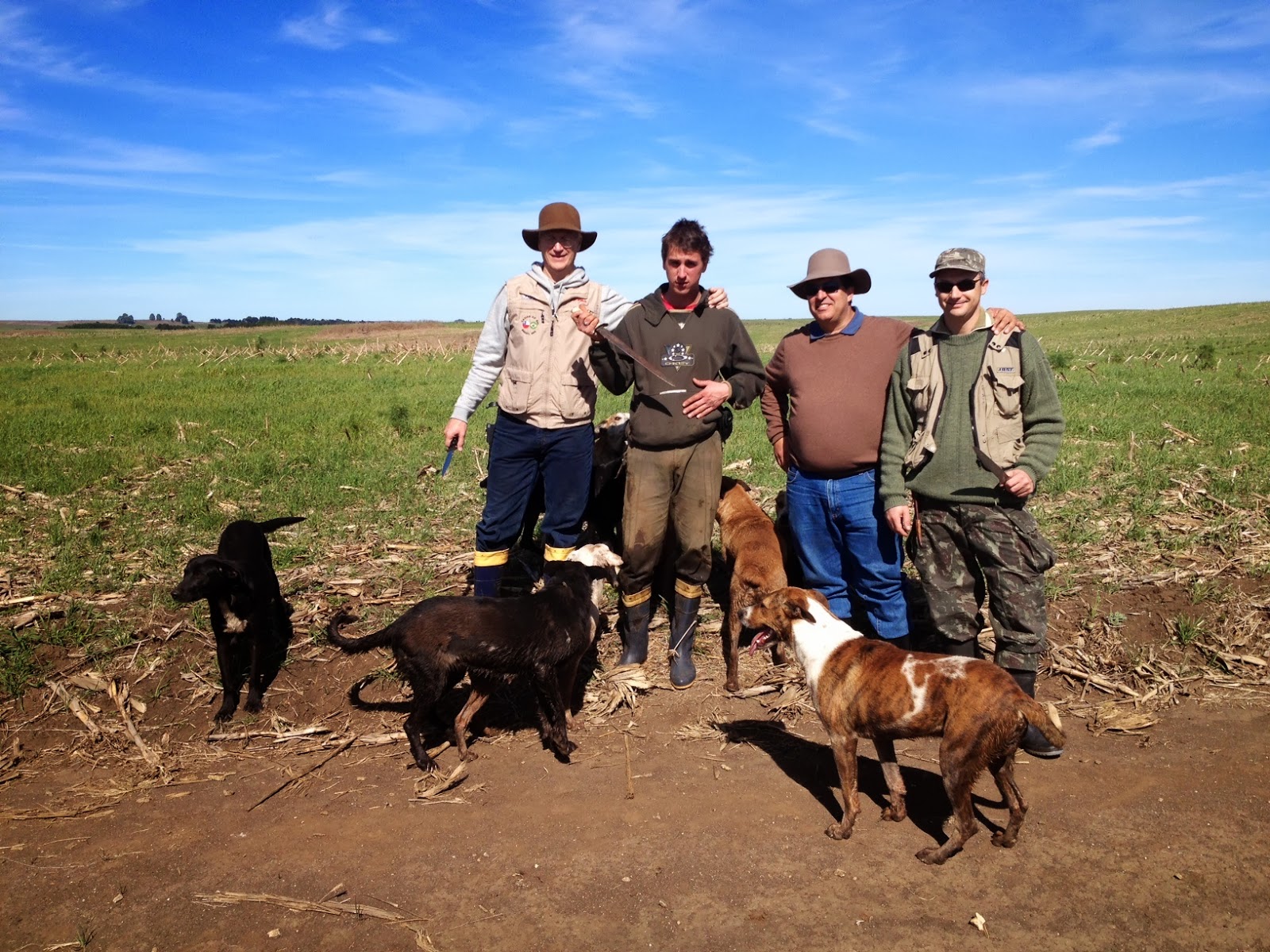
César, Tainar and his sword, the author, Ivandro

Last weekend I had went boar hunting for the first time in Rio Grande do Sul, Brazil, near the city of Bom Jesus.

It all started during a business lunch on Friday when we were having small talk and César mentioned that he was going boar hunting that night and the next day. Without any shame I volunteered to take part on the expedition, and pretty soon we had all arranged.

At 6:30 PM Ivandro and Gordo picked me up at the hotel, then we drove to César and finished loading the gear, which besides a couple 12 gauge shotguns and 308 rifles included rolled mattresses and a lot of blankets, as Brazil was facing record low temperatures.

After about two and half hours drive in tortuous single land roads we came to the 2,600 acres estância that we would hunt on, and immediately met the rest of the group, Kid and his son Tainar, and their friend Gordinho, and the first order was to uncorck some good wine, make some coppa and salami sandwiches, and of course start an almost endless exchange of tall tales and lie, which is rather typical of any gathering of hunters or fishermen.

Around 11:30 PM we went out for the first hunt, spotlighting for boar in two different trucks. The team developed a good technic: a heavy wool blanket is placed on the top of the truck cabin and secured by both back doors, and a shotgun or rifle can be safely placed on top. One spotter and a shooter travel on the bed.

When we left the temperature had dropped to just above freezing, and not fifty yards from the ranch house we saw he first animal, a graxain, which is a South American cousin of the fox that pretty much ignored our presence. Either graxains are not hunted or a very stupid.

Within the next several minutes or one mile we saw a couple lebrões (European hare) and an enormous Coati-mundi. Again, we left them untouched and continued our search for the invasive and illusion boars.

After wadding through a small river where some capybaras made their home, we came across a herd of steers that were looking for protection against the cold wind. We negotiated passage and left them behind. 

At the end of our eight mile drive we came to the edges of a large swamp, and very soon located a couple of the small veado catingueiro, which is similar to, but smaller than a brocket deer. We observed one of the animals for several minutes before it decided to bid us good night and look for more private bedding grounds.

When we started back he temperature dropped to just below freezing and we made to our galpão without much to talk about. After some more wine to warm up a bit we prepared our beds and bunked in completely dressed. The wind and total lack of insulation and heating (the lone fireplace was far away) forced us to use the heavy wool blankets to cover us from feet to head.

Saturday morning we had breakfast and had the unpleasant surprise of finding Kid's pick-up truck with three flat tires, both on the driver's side plus the spare, a reminder of some of the large potholes we found the previous night. This changed plans a bit, as we had to release the hounds by the ranch house and Tainar and Gordino would walk them to the swamps where we believed the boars were hiding, and it was a long, long walk.

The younger boys led the pack of hounds throughout several swamp patches over four or five hours, while we older, and in my case fatter, gentlemen surrounded the swamp. While walking around we flushed a couple perdiz, saw some marrecas (South American teals), and admired a very large carcará hawk. Later on while I walked he edges of a swamp I first hear the unmistakable pit-pit-pit of the narceja or aguaterro, the South American cousin of our dear woodcock.

Later in the morning while crossing a part of the swamp to meet some of the guys I heard the cryptic song of the siriema, a long legged snake eating bird, that enjoys running more than flying, and could be compared to the African secretary bird.

We stopped hunting around noon when it was already warm enough not to require a jacket anymore. We gathered the dogs, but could never take a good photo with the ten all together.

Fixing the tire was a hole different story and I will not bother you with it, and on our way home we stopped at a local restaurant and enjoyed a large fresh trout lunch. 

Although we did not see any boars during this hunt I was not bored at all. I had not hunted since my latest quail hunt in Alabama, back in March, and I had not seen so much animal diversity in Brasil in a long time.

I am sure that this was the first of many hunts that I will enjoy with my new friends, and saw some very large mounted hogs that are testimony to their presence in the region.

As a final note, after getting back to my hotel in Caxias do Sul I had a long hot shower, ordered some chicken and rice soup, and enjoyed a warm cozy bed for a very comfortable night.


Wednesday, July 3, 2013

From Fire & Steel

My creation with the Master at the forge


My wife asked which gift I wanted for father's day, and I said that I did not want anything, but while surfing the web I found something that I could carry with me for the rest of my life: a two-day knife making course!

The course was offered by Tillers International (www.tillersinternational.org) an organization that aims "To preserve, study and exchange low-capital technologies that increase the sustainability and productivity of people in rural communities," and the instructor was Tim Carr of Black Bear Forge (www.blackbearforgemi.com), a master blacksmith and bladesmith that has endless patience, skill and good humor, and that appears to be as strong as a black bear.

So, on Saturday, June 29th, I woke up at 4:00 AM to drive from Traverse City to Scotts, MI, which ironically is not more than five or six miles from my previous place of work.

Around 9:00 AM the seven or eight “students” watched the teacher demonstrate how to forge a blade from a strip of 5160 steel that used to be a suspension coil spring. Gently bringing the steel to a nice dull red on the coal forge Tim started to shape the little bar into a small and handsome blade, and when a master is at work, everything looks simple.

Shortly after we lighted our own forges, got our own pieces of steel, and started heating them to what looked like a dull red, placed the piece on top of an anvil and started pounding with the heavy forging hammers.

Immediately I remembered a story that Dr. Alexandre, a good friend from my hometown told me several years ago: Dr. Alexandre was at a bar when a samba group came to play, and he asked one of the members to teach him how to play the tambourine. The guy handled him the instrument and showed him the basic movements and after ten minutes he was able to follow the others. Then Dr. Alexandre asked if that was all and the musician answered that “This is all, plus thirty years of dew forming on your back.”

Just like any other activity it takes practice to make perfection, and I took quite some time to shape a blade that was passable, but less than perfect. Some of the other students actually forged two blades in the same amount of time, but as pounding at hot steel is a lot more demanding than pounding on a keyboard, I decided to play safe.

After forging we normalized the blade for three times and let it cool while we had lunch at the main house. Then we went to the belt grinders and carefully corrected the shape and cleaned the blade, and after that we drilled the handles and spent a LOT OF TIME polishing the blade by hand to get it ready for heat treatment. First heat it up in the forge to a good red with the edge up, then quench it in vegetable oil with the edge down. And then we polished by hand again until we had bright steel so we could watch the colors change during the tempering operation, which was done with a propane torch.

By this time it was almost 5:00 PM, and it was time to quit, as unlike my blade we were not made of steel. I called my good friend and hunting partner Greg Anderson and was cordially invited to join them for dinner at their home. Greg barbecued some excellent pork that was served with pasta salad and a zesty sauce on the side. There was also a delicious catfish. While Greg cooked I enjoyed some great conversation with his wife Linda and explored the contents and character of a bottle of Buffalo Trace.

Greg and Linda also invited me to spend the night, and I slept like the proverbial child. Next morning I said good-bye and went “back to school.”

Following my fight with the Buffalo, which apparently ended on a tie, it was time for more cleaning and polishing, and then it was time to select material for the handles (as 4th of July was just around the corner, I selected a laminated wood that had red, white and blue in it), cut to shape, drill and epoxy them to the knife tang. We used “Loveless” brass screws to hold the scales in place and also to provide some good looks.

After some 45 minutes for the epoxy to cure it was time to go back to the belt grinders to shape the handles, and then more hand polishing, this time for the handle.

The final operations were buffing the handle, and forming the edge with a 200-grit belt and final sharpening with a 600-grit one, and I immediately went looking for something to test my knife on. For the lack of better quarry, like a whitetail deer to skin and butcher of a good Brazilian style barbecue to slice and dice, I was content to shave the hair from a portion of my left arm in one swift motion.

Following Tim’s advise I made a newspaper sheet, less to protect the knife than to protect other surfaces and objects from getting cut by it.

I learned a lot during those two days. My knife is not perfect, but it is very functional. I was able to maintain a certain proportion and balance between blade and handle shapes and sizes, and while it is a bit on the heavy side, it is very robust and quite sharp.

I also learned to respect a lot more the work done by custom knife makers and other artisan. It takes a lot of time not only to make a knife, but also to get good enough to be able to make an attractive and flawless one. I am not sure I would ever make a living making and selling knives, but I really plan to further explore this activity as a hobby.

The first serious use I put my knife to, was cutting some hard salami into thin slices to prepare my Sunday dinner, as I was too tired to go out. Right now my knife is resting on my knife chest along over one hundred twenty of its relatives, where it will rest until hunting season, when I expect to be able to proof it on gutting, skinning and butchering the whitetail deer of my dreams!