The Essence of Life

The Essence of Life
Showing posts with label Peter Hathaway Capstick. Show all posts

Sunday, January 1, 2017

Letters From Famous Big-Game Hunters

The "Corresponding" Hunter

Continuing my quest to read all volumes of the Peter Hathaway Capstick's "Library of African Big Game Hunting and Adventure" (I currently have seven of the fourteen volumes) I just finished reading "AFRICAN ADVENTURES - Letters from Famous Big-Game Hunters", originally published in 1935 by Denis D. Lyell (1871 - 1946).

The limited information that I was able to find shows that Denis David Lyell was born in Calcutta, India, and that his family was originally from Dundee, Scotland. In 1893 he moved first to Ceylon and then elsewhere in India where he established himself as a tea planter. In 1899 he moved again to South Africa and then in 1913 he went to Nyasaland, currently Malawi, a landlocked country bordered by Zambia, Tanzania and Mozambique, and by all accounts some of the greatest big-game hunting grounds in Africa.

After World War I Lyell moved again, back to his family homeland of Scotland. From the time he came to Africa until his death he became immersed in the hunting world and became a renowned author, writing eight books between 1909 and 1935.

In his last book Mr. Lyell presents extracts from his vast correspondence with other famous British big-game hunters, such as Selous, Karamojo Bell, Stigand, Millais, J.A. Hunter, Sir Alfred Pease, Abel Chapman and others, and from this collection of private documents many unique insights from their more mundane aspects of their lives like how it is almost impossible to make a living from writing hunting books (believe me, I know this very well), to discussions on financing hunting trips, extensive discussion on the merit of the small-bore repeating bolt-action rifle versus the large-bore express guns, quality of ammunition and the amount of field failures, common in English made ammo, but unheard of in German made DWM (Deutsche Waffen und Munitionsfabriken), and going on and on and on.

These three paragraphs in a letter from Leslie J. Tarlton dated March 11, 1926 pretty much summarizes all discussions in hunting calibers since the advent of smokeless powder was adopted for small arms ammunition in the French 1886 Lebel 8mm rifle:

"On the much vexed question of small bores, do you not think it so greatly depends upon the skill and knowledge of anatomy possessed by the individual user as to what constitutes the best rifle?

"Karamoja Bell, I believe, swears by the .256. Personally I use a .275 high velocity, but I also think a great deal of the American Springfield, which with a 220 grain bullet is, I rather fancy, the best all round small bore in the world.

"I think the tendency to go in for 'Magnums' is being overdone, because they sacrifice smashing power for velocity and low trajectory. I have killed one or two lions with my little .275, with shots I did not expect to do harm, but at the same time it seems to me that with these very light pointed bullets one is always a trifle uncertain just what they are going to do in heavy muscles of the larger mammals. Take for example the brain shot at an elephant. I think if you got hold of Bell he would probably tell you that the reason he is so keen on the .256 Mannlicher is that the solid bullet, in addition of being very long and slender, is round tipped instead of the sharp Spitzer tip."

And in a letter from J.A. Hunter dated March 23, 1928, the final verdict is pronounced on the 30-06, despite the apparent British contempt for the so-called Colonials:

"Have used practically every make and calibre of rifles, and have good faith in the .256, .275, .280 Ross (in a Mauser action), .318 and .300 Springfield cartridge. The latter I was loath to try, being American, but the genuine Mauser with 24 in. barrel taking the .300 cartridge and 180 grain bullet is a most perfect small bore weapon with great stopping power."

And who can argue that the 30-06 is the best all around hunting cartridge in the world?

In other chapters there is extensive discussion on hunting ethics, where Theodore Roosevelt behavior while in the "African Game Trails", both regarding the amount and quality of shooting is severely criticized, and game conservation, where the USA is applauded: "That is a country where people have awakened to the value of the big game, and where they are now taking wise steps to the protect it."

Well, this is getting too long, so I will stop before I quote all the book, and deprive you the pleasure of reading the book yourself.

Sunday, March 20, 2016

Airgun Therapy

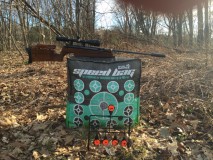
Walther LGR and Target Set-up

Last week while reading Vin Sparano's anthology "THE GREATEST HUNTING STORIES EVER TOLD" I came across Jim Carmichel's "The Great Jonesboro Pigeon Shoot" and that reminded me that I have been neglected one of the greatest form of shooting anyone, Professional Small Boy or not, can dream about: airgunning.

If you dive though the different posts in this blog you will come across half a dozen or so air gun related postings, but my writing is rather primitive when compared (if it could be compared at all) to Mr. Carmichel's.

Another great writer that also penned some fantastic airgun words is the late Peter Hathaway Capstick, who I believe coined the term professional small boy, which I still shamelessly. Two of the best Capstick's air gun stories are "Backyard Safari" and "Mini Sniping."

One or way or the other I have lived similar experiences as those described by these gentlemen. I may not have shot pigeons out of a court room, but I did that out of fertilizant plant and from the middle of a park in an undisclosed South American country, and while I have not bagged the dreaded bull Gundwan, I have stalked and terminated the dangerous saurian Ameiva ameiva, also known as "Jungle Runner" or South American Ground Lizzard.

I've also spent countless hours with friends or alone in my basement airgun range, mostly shooting at reactive targets for the almost instantaneous gratification of seeing a target flipping or flying. Many of the different targets that I shoot at are improvised: playing cards hanging from binder clips that are suspended from a cooper wire, spent .22 LR or center fire pistol cartridges set on golf tees (the only practical use that I have for an golf equipment), and any other thing that is same to be shot at. I also have a very nice Gamo running deer target (Gamo MTS 1000 Moving Airgun Target System to be more specific).

But with spring coming to Traverse City, and beautiful sunny days ahead, cold or otherwise it is indifferent, I just could not bear the thought of being in the dungeons and wanted a set-up that would allow me to enjoy airgun shooting in my backyard.

In the past, shooting an airgun in the backyard could put you in trouble with the law depending on where you lived in Michigan, but since July 1, 2015 airguns are no longer considered firearms, and as part of the provisions in the Air Gun Reclassification Package "these devices cannot be regulated on private property where authorization is given and the possessor takes precautionary measures to ensure that the projectile remains within the bounds of the property."

So yesterday night, when I stopped at the local Gander Mountain to buy my spring turkey license, I bought a Caldwell Resetting Airgun Target System Steel (if the Gamo is called the MTS, then this one should be called CRATSS), and this afternoon I inaugurated my new private outdoor range.

I placed the CRATSS in front of one of my archery targets to have a large and dependable back stop, placed a chair at about 20 meters and started banging at the target. Actually, my Walther LGR is so quiet that the only noises that I could hear were the hammer striking the valve and the pellet hitting the target (or the backstop if I did not do my part.)

The 10X scope on the LGR is dead on at 10 meters (the distance I generally shoot in the dungeon - sorry, the basement - and I found out that the first MIL-Dot above center was dead on at 20 meters, and when I moved to 30 meters I just had to go back to the center of the crosshair.

The cold wind blowing from the West Arm of Grand Traverse Bay easily pushed the pellets an inch sideways at the distances I was shooting, and with time the near freezing temperature started to take its toll on my finger tip sensibility. Finally, the setting sun started to play a torturing game of shadows and mirages. This was a great reminder of how much more challenging outdoor shooting is than when done in the controlled environment of an indoor range.

My next plan is to set a regulation Mini Snipping range. Of course I will have to get permission from my wife, as she is the only grown-up around the household. I will keep you posted on that, provided she allows me.

And tomorrow, the Brown Truck is supposed to bring me another Walther: a .22 caliber LGV high power spring piston. You know, professional small boys just cannot have enough toys!

Wednesday, January 7, 2015

Killers in Africa


I just finished reading "KILLERS IN AFRICA, The Truth About Animals Lying in Wait and Hunters Lying in Print" by Alexander Lake, published in 1953, and while it is an absolutely entertaining book, it raised some questions about another book, from one of my favorite "non-serious" writers, Peter Hathaway Capstick. But more about that later.

Mr. Lake was born in Illinois and raised in Michigan, and moved to Africa with his father (or family) in his teenager years. He apprenticed under prominent hunter Nicobar Jones and made a life out of hunting and guiding during the first half of the twentieth century.

According to Mr. Lake there is very little real danger in hunting big-game (by big game we should understand as "the ones that bite back!"), but "Each man was mauled or killed through his own ignorance, or careless, or reckless, or a poor shot, or hysterical, ir dependent on native gunbearers for support." Or in the words of the great Brazilian writer Jorge Amado, "those that are not competent cannot get established."

Besides the Big Five (Leopard, Lion, Buffalo, Rhino and Elephant), the book covers Hippos, Crocodiles, Snakes, Baboons and Antelopes. Mr. Lake's closest calls came while hunting chacma baboons and that reminded me of a history that Ed, a professional hunter that I met during my first time hunting in Africa with Mankazana Safaris. Ed told about a Norvegian hunter that was a police sniper and that would come to Africa and spend most of his time hunting baboons, because it was so close to hunting people! Ed was very clear about how afraid he was of the viciously dangerous baboon, particularly when they had to enter thick bush after a wounded baboon, 12 gauge pump gun in hand.

Regarding animals that are called "plains game" nowadays (what a misnomer), Mr. Lake says that "There is satisfaction in African antelope hunting beyond anything the big-game hunter will ever know. There can violence, too, for wounded kudu, sable, or bushbuck can be ugly customers whose slashing hoofs and sweeping horns can kill as surely as lions' fangs and claws."

Mr. Lake rightly did not believe in "shock" killing power and did not favor big-bore or double Express rifles ("Don't kid yourself that you can hit a big-game beast just anywhere with a .600 Nitro-Express and drop him cold every time."). He advocated careful bullet placement, and preferred "a military Lee-Enfield .303. If deprived of my .303 I'd be perfectly happy with a 6,5 mm Mannlicher-Schoenauer and a 160 grain bullet; with a .270 Winchester and a 150 grained soft-nosed bullet; or, for that matter, i'd be satisfied with any good modern rifle of comparable size."

One of my favorite passages in the book is when he is teaching a young prospector named Sachse how to hunt and engages on a discussion with other members of the expedition and says: "True hunting is never butchery. It's almost one hundred per cent sportsmanship. A true hunter has a sympathetic bond with animals. He tries to kill quickly and cleanly and never permits a wounded animal to suffer for long. Just now Sachse spoke of an 'urge' to hunt. Shows he's normal. Hunting's an atavistic urge and usually a healthy one."

The other is his discussion about the proper diet for a person that wants to hunt in Africa. "Unless you've been on a good meat diet and eaton your food well salted, you'll find yourself strangely weak and listless when energy is most needed. If you're a man who lives exclusively on fruits, vegetables, and grains, chances are you won't be able to endure a prolonged African hunting trip." And for a couple pages he goes on about the importance of carnivorous diet. I apologize for my good vegetarian friends in India, but I just love it!

But back to Capstick! The structure of Capstick's "Death in the Long Grass" (1977) is REALLY similar to that of "Killers in Africa" (1953), but a quarter century later. And if you read the Snakes chapter in both books you will find frigthening similarities on the stories about a matting couple of black mambas, especially when both snakes' heads appear over the long grass! I really love and cherish Peter Hathaway Capstick books and the way he writes, but for a long time people have questioned if he wrote fact or faction, and of all the adventures that he wrote about happened to him or to someone else. Well, in this case, evidence is against him.

In any case, I will read again Capstick's books and will look for more Alexander Lake books as well! And I recommend you to do the same, as both have had significant more hunting experience and write much better than I.