The Essence of Life

The Essence of Life

Sunday, April 15, 2012

Pope on Hunting

Saxton Pope
Bow hunting is an art and a challenge. It took me 9 seasons to bag my first whitetail deer using bow and arrow (see my post “Appointment in Bangor” from October 2011), and along with the black bear that I also shot using bow and arrow in Ontario in August 2010 those are among the highlights of my hunting life.
While hunting with bow and arrow is clearly more challenging that with a firearms, I don’t think that this lessens the firearms hunter, especially since I do both. We need to be united as a hunting community, and cannot let ethics be confused with preferences (for an excellent article in this subject, click at the link http://www.huntright.org/where-we-stand/ethics-vs-preferences). We must keep in mind that united we stand, and if we brake our ranks we will fail and those that wanted to prohibit hunting and see men apart from nature will prevail.
But this is not the reason that I am writing about. On my last posting I talked about the “Love of the Chase”, and tried to articulate the reason of why I hunt, probably in a very clumsy way, but while reading Hunting with the Bow and Arrow” by Dr. Saxton Pope, one the fathers of modern archery, I came across a passage called THE PRINCIPLES OF HUNTING, that I reproduce below. I only wish I could write as well as Dr. Pope.
In the early dawn of life man took up weapons against the beasts about him. With club, ax, spear, knife, and sling he protected himself or sought his game. To strike at a distance, he devised the bow. With the implements of the chase he has won his way in the world.
Today there is no need to battle with the beasts of prey and little necessity to kill wild animals for food; but still the hunting instinct persists. The love of the chase still thrills us and all the misty past echoes with the hunter's call.
In the joy of hunting is intimately woven the love of the great outdoors. The beauty of woods, valleys, mountains, and skies feeds the soul of the sportsman where the quest of game only whets his appetite.
After all, it is not the killing that brings satisfaction; it is the contest of skill and cunning. The true hunter counts his achievement in proportion to the effort involved and the fairness of the sport.
Here we have a weapon of beauty and romance. He, who shoots with a bow, puts his life's energy into it. The force behind the flying shaft must be placed there by the archer. At the moment of greatest strain he must draw every sinew to the utmost; his hand must be steady; his nerves under absolute control; his eye keen and clear. In the hunt he pits his well-trained skill against the instinctive cunning of his quarry. By the most adroit cleverness, he must approach within striking distance, and when he speeds his low whispering shaft and strikes his game, he has won by the strength of arm and nerve. It is a noble sport.
However, not all temperaments are suited to archery. There must be something within the deeper memories of his inheritance to which the bow appeals. A mere passing fancy will not suffice to make him an archer. It is the unusual person who will overcome the early difficulties and persevere with the bow through love of it.
The real archer when he goes afield enters a land of subtle delight. The dew glistens on the leaves, the thrush sings in the bush, the soft wind blows, and all nature welcomes him as she has the hunter since the world began. With his bow in his hand, his arrows softly rustling in the quiver, a horn at his back, and a hound at his heels, what more can a man want in life?

Note: The book “Hunting with the Bow and Arrow”, as well as many other fantastic books, can be downloaded for free at several internet sources, including www.Amazon.com and Project Gutenberg (www.guntenberg.org).

Thursday, April 12, 2012

The Love of the Chase

Uruguay 2008 with Ariel
Over the years I have tried to answer the question of why I hunt using rational and scientific argumentation, talking about the negative impact of human development over nature, the virtual elimination of predators and other animals that compete with society’s scarce and disputed economic resources, and rationalizing that the only way to preserve a piece of nature or a little bit of wilderness is by extracting an “economic surplus” from them, and that only hunters, among all members of society, are willing to allocate the time and money to manage nature in such way.
However, as I began to dedicate more time to hunting and the outdoors I also tried to explore not only why I loved to hunt but why I had to hunt. Which compulsion would make me crave for autumn and winter and dislike summers or how could I explain to my wife that I am not trying to punish myself when I wake up long before first light and go out in inclement weather to hunt or worse yet why I spend more money on my Labrador retriever than on our children college fund?
After chasing it for many years, from when I hunted quail and shot fish in my childhood in Brazil to going on safari in Africa, I believe I finally found the answer to such pressing and profound question. It is still rational and scientific, but biological and philosophical instead of economical in its content.
I am not an anthropologist or a philosopher to write a treaty on human evolution or meditate on hunting, I am a hunter, and as a hunter I can say that deep in my genes and in my soul the predator lays, patiently waiting for opportunities to surface and strike upon its prey. I hunt because I am a predator. I am on the top of the food chain and as part of nature I must perform my ecologic function, occupy my niche, and feed on my prey.
Although detractors of hunting would like us to believe otherwise, Homo sapiens are as integral and important components of nature as any other creatures, and as we went through a similar evolution process as all those living creatures we evolved as the most successful predator this planned has ever had. Evolution shaped us not only physically but also emotionally and psychologically, and not even in our modern yet stupid time will misguided and ill-intentioned people be able to negate that.
Of course, it could be argued that humans being rational creatures should be able to control their most basic instincts, but by doing so we would only further remove ourselves from the natural world and then nature would play a constantly diminishing part of our life until by being ignored for so long it would be forgotten. And if nature becomes unimportant by being ignored and forgotten what can we expect that will become of it, a wasteland of shopping malls, golf courses and subdivisions or worse yet a dump yard for human rejects?
By castrating our instincts and not hunting we would not only deny ourselves the much needed vacation from our demanding lives and pressing (and some times depressing) routine, the human condition as mentioned by Ortega Y Gasset, vacations in which man can develop true happiness but also risk developing a total disregard for nature, a disregard that could have a most terrible outcomes, the end of all wilderness within human reach.
Hunters, more than any other group in human society, are responsible for conservation since we not only want to be able to hunt today but also in the future, and we want our children and their children to be able to have as close a communion with nature and we do. Hunters have a symbiotic relation with their prey, while hunting provides us nourishment for body and soul, we make our prey stronger by helping providing suitable habitat and maintaining the prey population within the habitat’s carrying capacity. Hunters interact with their prey year after year after year.
Because of this constant interaction between hunter and hunted, predator and prey, at one time I was afraid that the burning ember that keeps the predator alive deep inside us could be extinguished either by lack of fuel or by too much fuel but I no longer worry about that. Due to circumstances of life I had to spend many years without hunting. It was hard but I endured and Hemingway, Ruark, and other close friends kept the ember burning. On the other extreme I was exposed to Africa and not even its abundance of game could tame the predator inside me, for all the excitement of the chase was present again on the first opportunity, either shooting a pheasant over my dog or drawing my bowl at a whitetail doe.
The excitement and trill of the chase, the fulfillment that it gives us, reminds me that men are entitled basic rights, among them “the pursuit of happiness”. But, happiness is a state of mind, is doing what we like, pursuing what gives us pleasure. Happiness is in the action, not necessarily in the achievement. Ortega Y Gasset really captured the essence of men’s pursuit of happiness in saying that “the hunter does not hunt in order to kill; on the contrary, he kills in order to have hunted”.
And, since the happiness is found in the action, and the continuation of that action, not necessarily in the achievement, then, I hunt not only because I am a predator, but I hunt in order to be happy.

Friday, April 6, 2012

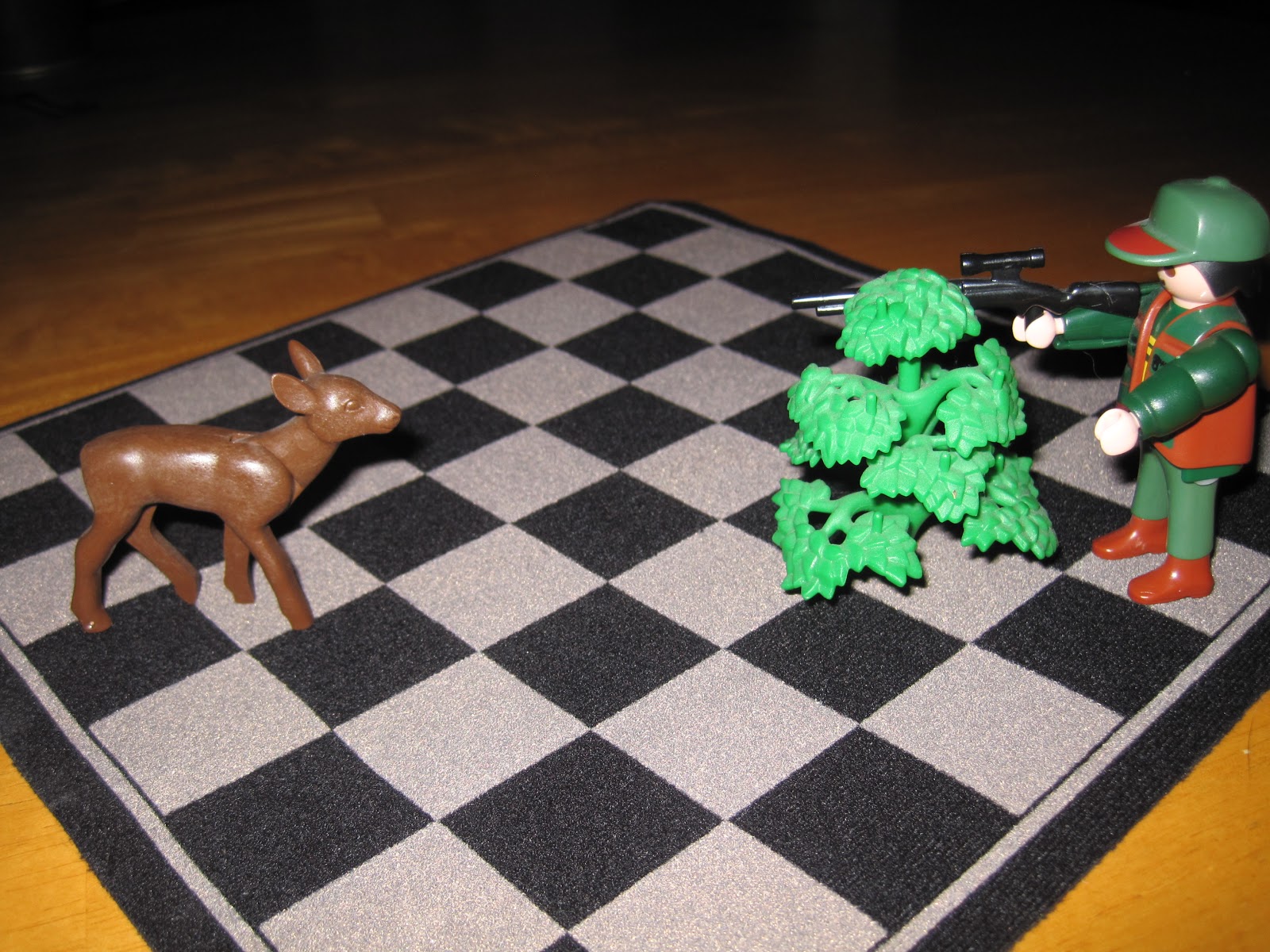
Chess Game


Probably the greatest benefits that I have from writing the posts for my blog is that I can exercise my memory and remember some occasions that were really special.
In the seasons of 2003 and 2004 I hunted deer (or was taught how to hunt deer) with my friend Bob Scott at his place in D Avenue, between Kalamazoo and Gobbles. I told the story about the 2003 hunt in my book “A Wild Beast at Heart”, in the chapter “Opening Day”.
I just can’t remember where I hunted in 2005, but that is probably when Bob took me bow hunting a couple times. I was immature enough to blow a chance at a nice eight pointer that Bob shot later on the same day, and also moved to hastily and spoke several does at dusk on another day when I was on a tree stand for the first time.
Soon after that Bob and Pam sold their “D Avenue” home and acreage and moved into town, and suddenly we no longer had access to a property were to hunt.
During the summer of 2006 my son Daniel and his friend Ryan discovered the “secret pond”, which is formed by the Whisky Run creek, and could be reached by foot from our subdivision. As I knew that it was located in private property, I escorted the boys to the home of the owner and told them to ask permission to visit the no so secret pond.
When deer season was around the corner, I went back to the same farmer and asked if I could have permission to hunt his property, or even if I could lease the hunting rights for a portion of it. After much talking he gave permission to hunt the Northwest corner of his property that comprises a corn field by the road, small woods and a swamp.
I took opening day, a Wednesday, off work, and by o’ dark thirty I left home for the three minutes drive to my new hunting grounds. I set a camping chair by a fence among bushes and started long wait for first light.
In the morning there were song birds of all types, but no deer, and at around 11:30 AM I went back home for lunch with my wife. Just as I got on the road I doe crossed it. After lunch I watched “La Dolce Vita”, the fantastic 1960 Federico Fellini movie staring Marcello Mastroianni and the gorgeous Anita Ekberg. After the rather sad ending, I returned to my hunting post.
After a lot more bird watching, when dusk came and I was getting ready to leave, I saw a beautiful eight or maybe ten point buck and had a terrible case of buck fever. The problem is that besides all my trembling, that buck was looking straight at me from seventy or eighty yards away.
I took a hasty shot; the buck jumped the fence and disappeared in the swamp never to be seen by me again. I looked a lot for blood, but the shot was a clear miss.
On Saturday I went back to the same spot, and continue to watch birds. This time a group of does came from behind me by mid morning. The wind was on my face and they soon scented me and got hell out of Dodge.
On Sunday I relocated my chair to try to spot the does before they could scent me, but they came by a different path, and although I could see them coming I never had a shot before they spooked.
This was becoming an intriguing game of wits.
During the week I had to work, and on Thanksgiving Day we went to Holland, Michigan, to visit with our friends Clóvis and Sandra. As we were leaving the sky was clear and stars were everywhere, I the air carried a cool bite. I sensed a frost for the next morning, and confidently told our friends that I would shoot a deer the next morning.
As the family left for “Black Friday” I left for my usual sitting place and found that the corn had been picked. I relocated my chair to have a better view of the swamp and the “doe highway”, and started the wait. This time the group of does came at the outer edge of the swamp, and when they were about thirty yards from me, there was a loud snort and took of running. Immediately I left my chair and found cover behind some bushes.
They went up a slope and most of them disappeared behind it, but the largest doe turned back and started stumping its front paws while trying to locate me. There was just enough ground behind her, to make an uphill shot safe, so I placed the crosshairs of my scope at her chest and let go a Lightfield slug.
It was like hitting a toy with a sledge hammer. The doe flipped backwards, and disappeared in the corn stubbles. I quickly came looking for her and found a very large and fat doe, very dead on the spot she was hit.
I paced the distance back to the bush that I hid behind and counted about ninety yards. No bad for an off-hand shot.
After field dressing the doe I took her home and waited for my family to come home. The only pictures that I have are completed out of focus, courtesy of the bad mood that my teenager daughter was in.
While butchering the doe I found the lead slug resting against the hip bones.
After eating all the venison, the only trophies that I have from this hunt are two out of focus photos and the memories of the great chess game those does and I played. This again proves that antlers or horns are not required to make a hunt successful.

Friday, March 30, 2012

The Best Piece of Gear I Ever Bought

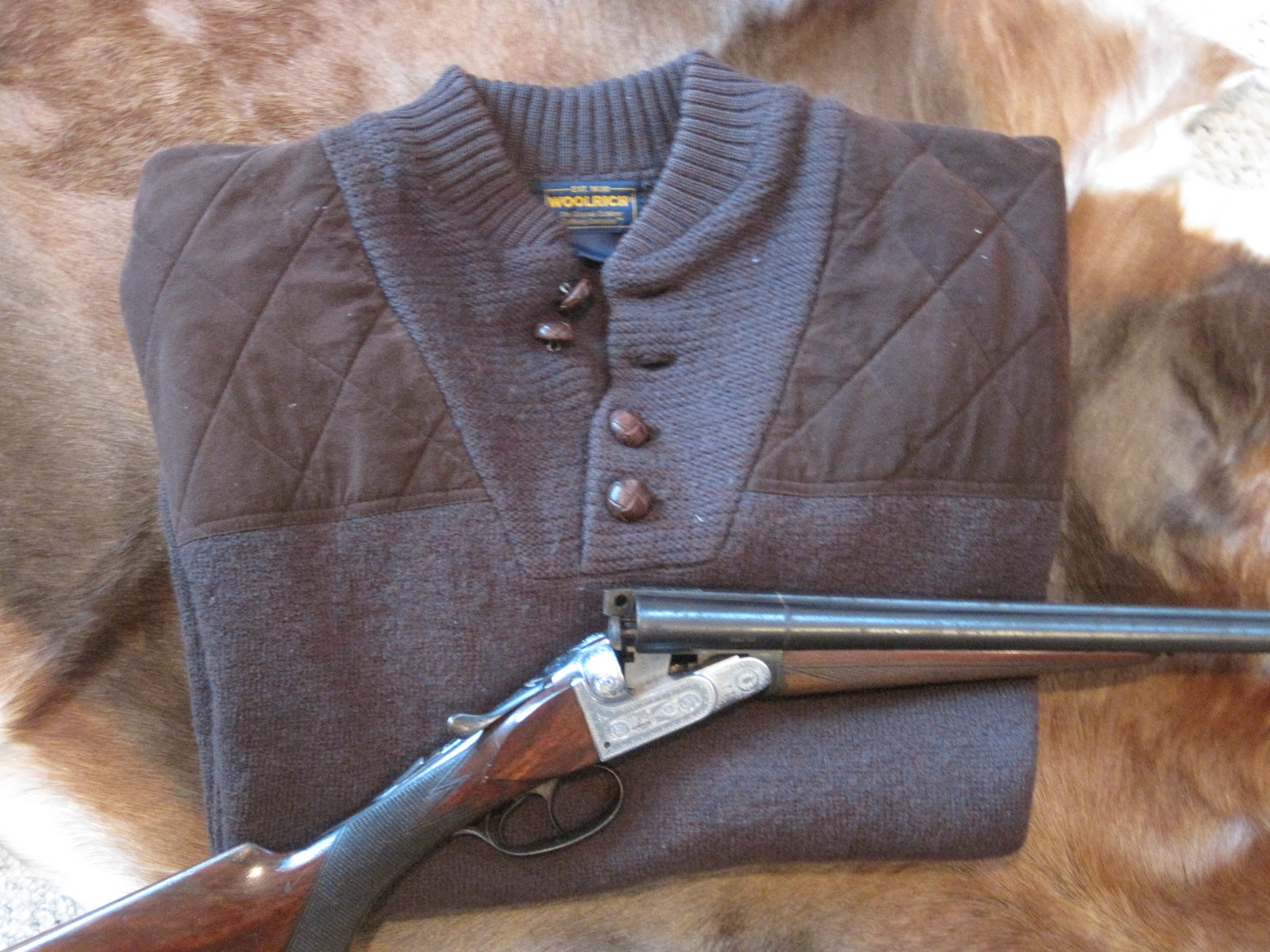
Woolrich Sweater
It is hard to deny that I am an impulsive buyer, but once in a while that pays off.
In January 2003 I attended a corporate innovation summit at the Grand Traverse Resort and Spa, and apart from a lot of snow and very long and a treacherous drive back home, a bad development program that never got anywhere, the one positive thing that came out of that trip was a new sweater.
There was an Orvis shop at the hotel, and they had a very attractive Woolrich 100% wool sweater for sale. The price was an outrageous one hundred and twenty dollars, but just after checking out I bit the bullet and bought the brownish-green or greenish-brown piece of clothing and took it home with me.
Almost ten years later, this sweater, that I am wearing as I write this words, is probably the best and most useful piece of gear that I ever bought. I used it to hunt in Michigan, North Dakota, Arkansas, Ontario, South Africa and Uruguay. It is absolute quiet, warm even when it is wet, so well cut that it can be used in social occasions (although it is starting to show signs of age and some damage from brush and brambles).
Along with my Swiss Army Knife (about which I will talk in the future), I don’t think that there is a piece of gear that I ever used more than my Woolrich sweater. The only problem with it is that it is no longer available.
As Gene Hill once mentioned in one of his books, anytime we find a very special piece of gear; be it a hunting jacket, a pair of boots, or a sweater, and we fall in love with it, it goes out of catalog and we will never again be able to find a replacement.
I recently bought another sweater from Orvis; it is a nice Beretta green wool with windshear lining. While it may complement my old Woolrich, it will not replace it.

P.S.: The shotgun in the picture is a little Beretta side-by-side 28 gauge that my mother bought to my father as a wedding gift. This is the gun that my son used to shoot his first bird on the day of my father’s funeral. I tell this story on the very first posting of this blog “Last Bird, First Bird”.

Monday, March 19, 2012

How I Got Started in Wing Shooting

Photo by Aluísio

 
I was raised on a farm in Northern São Paulo state in Brazil and a day in 1976 we moved to town so I could attend school since there were no school buses and the sixteen miles of dirt roads were in many cases impassable during heavy rains.
We continued to come a lot to the farm, for weekends and vacations, but as the years went by, the house built in 1954 started to show signs of age, especially the old wooden windows and particularly the one in the “boys’ bedroom”, and no matter how you tried to close it, there was always some crevice or opening left.
So, it became very common for us to find bats in our room, and that was always a great time to train anti-aircraft artillery. We first closed the door so the grown-ups would not be aware of the intruder, then stuck a pillow into the gap of the window, removed our shoes and started to throw them at the bat.
Needless to say that since shoes do not have proximity fuses or the pattern capabilities of good shotgun shells it took a lot of “rounds” to bring the flying rats down, and after many such battles the ceiling got a lot of permanent marks from the mud and cow dung in our boots.
Next came a CBC 310 (8 mm rim fire) single shot shotgun. Although I shot mostly birds, I used the little gun almost as a carbine, as I stalked my prey as close as I could to make sure that the small charge of No. 12 shot hit its target (the most covered of which was the big white-winged pigeons or Asa Brancas (Paragioenas picazuro)), and that probably would not qualify as wing shooting.
If I remember correctly the first bird that I ever shot on the wing was a quero-quero (Vanellus chilensis) during a July vacation in our farm in Goiás state, central Brazil. As I walked along a two-track in a field the bird started to fly over, probably trying to protect its nest, and when it was floating on the wing I shot it with a 28 gauge side-by-side shotgun. I examined it and found that the quero-quero has spurs on its wings, and then left it behind. The next day I only found some feathers, and felt less bad for having provided a meal for some poor scavenger.
Not until after I got married I shot a couple rounds of trap and some friends allowed me to use their reloading presses to make some proper shells, plastics hulls and wads and 11/8 ounces (32 grams) of 7½ shot. If I remember one thing in particular is that those shells kicked much harder than the calves we had in the corral.
Things really changes when we relocated to Michigan and by accident or fortune we bought our home less than five miles from the Southern Michigan Gun Club outdoors range, and I started shooting skeet and buying new shotguns on a rather regular basis.
From my humble battles with bats, I have now hunted birds on the wing in Brazil, Uruguay, South Africa, Michigan, Indiana, North Dakota and Arkansas, and currently I regularly shoot clay pigeons in Michigan and Italy, but I must say that almost nothing that flies compares to the big white-winged pigeons that come just before sunset to roost in the giant bamboos of a certain farm in a poor country where all hunting is outlawed.
Even with all the opportunities that I currently have, another day I was almost homesick when my mother told me that my nephews had their first encounters with bats at the farm house. Poor kids, their shoes probably do not fly as well or hit as hard as my brother’s orthopedic boots.

Saturday, March 17, 2012

Short Traveling Notes

Piazza Solferino, Torino
I am back in Europe, hunting new business, but I am never very far away from real hunting.
I brought two books in the trip. Kuki Gallman’s “Sognavo L’Africa” (I Dreamed of Africa), which I finished yesterday, and Bob Munger’s “Trailing a Bear”, that describes his many trips and adventures with Fred Bear. I already had watched the movie “I Dreamed of Africa” and read the book in English, but I picked the Italian version on a street market some weeks ago in order to help me improve my Italian grammar and vocabulary.
On Thursday we traveled from Baden-Baden to Frankfurt by car and besides the ever presented elevated hunting stands (in a small field I counted five!), I saw a beautiful colorful rooster pheasant at the corner of a plowed field, and not ten minutes later a saw a Roe buck with nice antlers walking across a field parallel to the tree line.
On Friday, coming back from Tczew to the Gdansk airport I spotted a larger deer, probably a red stag hind still wearing its grey winter coat not too far from the highway.
Finally, today I had lunch at the Cantina Barbaroux in Torino. In their menu they say that this is longest continuously operated cantina in Torino, established in 1902. The main dish was “arrosto di cinghiale con polenta” (roasted wild boar with polenta), and it was good enough to lick the plate, or almost. I used some bread to savor the last drop of sauce and juice.

Thursday, March 8, 2012

The Most Flexible Gun


Remington 870 Express


One of the first things that I learned when I started my engineering degree is that we should not become a specialist that could only solve one type of problem, nor be a generalist that could not solve any problem well. In order to be successful we need to achieve a certain balance, be the expert in some areas, but have good level of knowledge over a broader field of our activities.
In many ways, this rational also applies to most fields of human activities. A Formula 1 car is only good to race inside a track, and if you try to use one to take your groceries home you may face some major issues. On the other hand, an average mid-size sedan is a much more flexible vehicle and will better meet the needs of a greater number of people.
Guns are no different and some firearms are so specialized that they only perform well in certain situations and are in many cases impractical for almost any other use. Examples of ultra specialized guns are free pistols, which are single shot .22 LR open sighted handguns with a extremely light trigger and no safety, a dedicated American Trap single shot shotgun with a release trigger (and no safety), or a large bore (e.g. .450” and up) double barrel express rifle. While each of these guns excel in their specialized application, like the Formula 1 car, they are not much good for almost any other use.
But there are some guns that are much more utilitarian, and although they may not be the best for certain specialized or eccentric needs, they are will perform a large number of shores exceedingly well.
I hunt birds as well as large game, enjoy “clay pigeon” shooting a lot, like to shoot for fun, and believe that it is a good insurance policy to keep a firearm for home defense, although I hope that I will never need it for the last purpose.
I also have many different guns that I can choose for each different shooting discipline or hunting condition that I am likely to face, but many times a question comes to me: what if, by some terrible force, I had to live with only one gun? Which one should I choose?
The traditional answer for this question generally takes us to central Europe, or more specifically Germany and Austria, where combination guns have been popular for as long as one can remember. These guns may have two, three or even four barrels, and as a rule combine at least one smooth bore and one rifled barrel, thus allowing the hunter to hunt large or small game, and shoot game on the wing or at several hundred meters (remember, these are European guns and they only understand the metric system).
While these combination guns are certainly flexible, they do have some drawbacks. First they are expensive, in general very expensive. Second, they tend to be a bit heavy and cumbersome. Third, they tend to be mechanically intricate, or in simple words they follow the old German axiom, why make things simpler if you can make then complicated and they still work.
Finally, and due to the third point, too many things can go wrong with complicated systems, especially operator error. I have read and heard too many stories about pushing the wrong button, sliding the wrong lever, or pulling the wrong trigger and setting the wrong barrel off. The typical results are shooting a pheasant with a 9,3x74R mm bullet, or a jaguar or eland with a load or bird shot, which is at least a bit annoying.
My approach for a very flexible gun is not particularly high tech, and many would consider it almost mundane. It is very affordable or almost inexpensive, very handy and extremely simple.
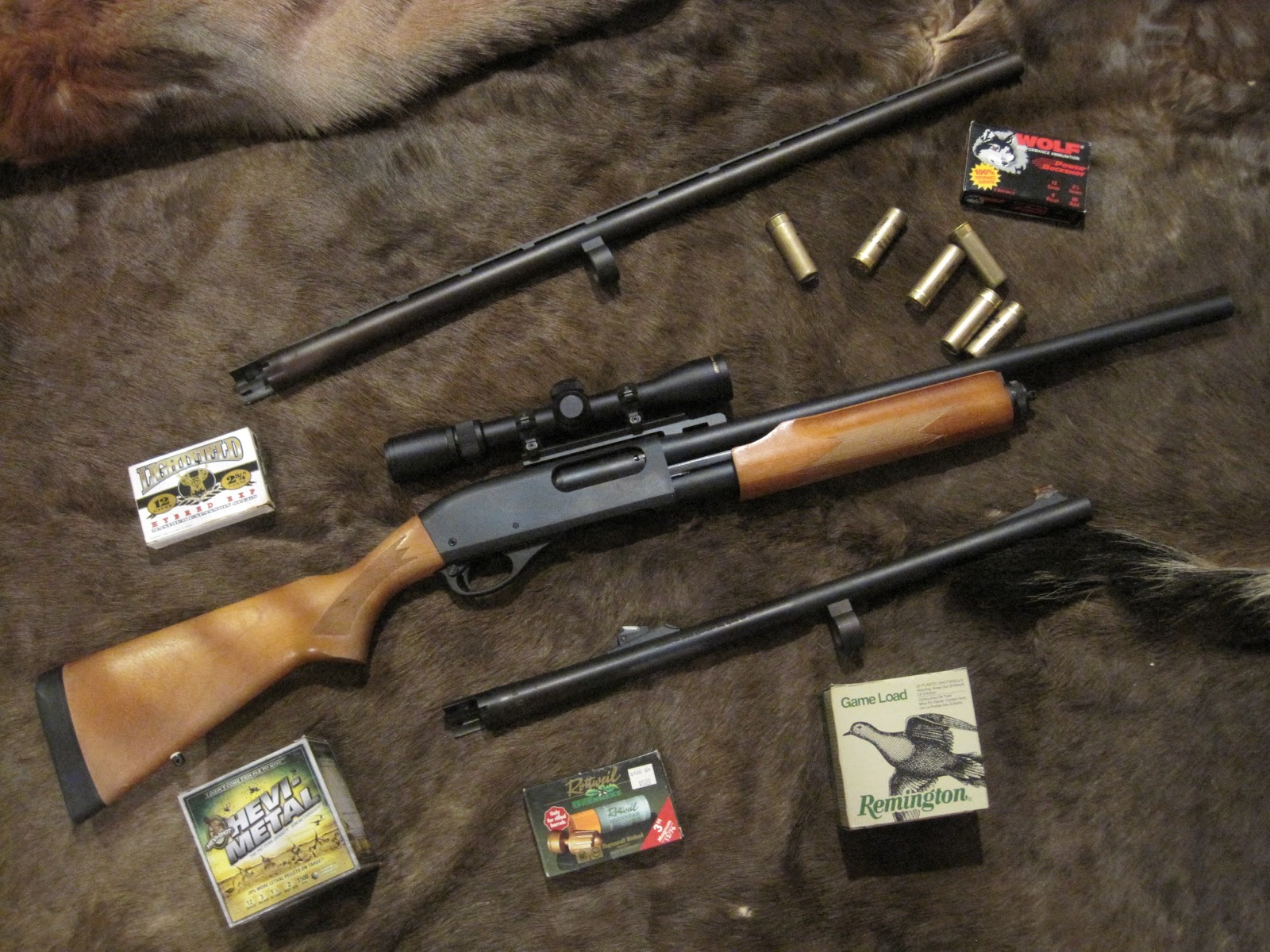
As you already guessed from the picture above, I choose my 12 gauge Remington 870 as my most flexible gun. Besides the inherited flexibility of shotguns (just pick the right ammunition and they will get the job done), the 870 pump action design and easy to change barrels allow it to perform very well under very different situations.
The short 18½” (470 mm) barrel combined with the five shot capacity and fast pump action provide me with one of the best home defense gun that has even been conceived. The same or similar set-up has been used for police and military work for over a century, and although we will find new “combat shotguns” with a lot more features, the Remington 870 is still the standard against which all others are measured against.
The same short barrel, either loaded with buckshot or Brenneke slugs, makes a wonderful gun to hunt in heavy bush or swamps. You could be after wild boars, deer or even a wounded leopard and not be under gunned.
Then there is the 23” (584 mm) fully rifled cantilever barrel. In my case it is topped with a Nikon ProStaff 2-7x32 scope, and the only ammo I shoot through it is the Lightfield Hybred EXP slugs. I shot deer at over 140 yards with this combination and I believe that it can be pushed a bit farther. The 546 grain 12 gauge projectile with 2,549 ft./lbs of muzzle energy makes this round capable of taking almost any game in the world, the few exceptions being buffalo, rhino, hippo and elephant. Although not ideal, the 870 with its slug barrel could be used as a “battle rifle” or even as mid-range varmint gun.
Next comes the 28” (710 mm) ribbed barrel with screw in choke tubes. This is the barrel that gets the most use, as it is used for small game, upland birds and waterfowl, and skeet, trap, five-stand (Compaq), sporting clays, and any other form of shotgun games. It is also the most flexible of the three barrels that I have, and the one that I would pick, if I was forced to just one barrel, as it can shoot bird or buck shot, slugs and almost any thing that fits inside it.
There are other guns in the market that could be as flexible as the Remington 870, but to my tast, the 870 delivers the best value and handling of all of them.
It is great to have options, buy, sell and trade guns now and then, day dream about new adventures and choose which gun to use for each different activity. On the other hand, it is reassuring to have one good “go to” gun. That most flexible gun that you know will get the job done.